
Written by AI
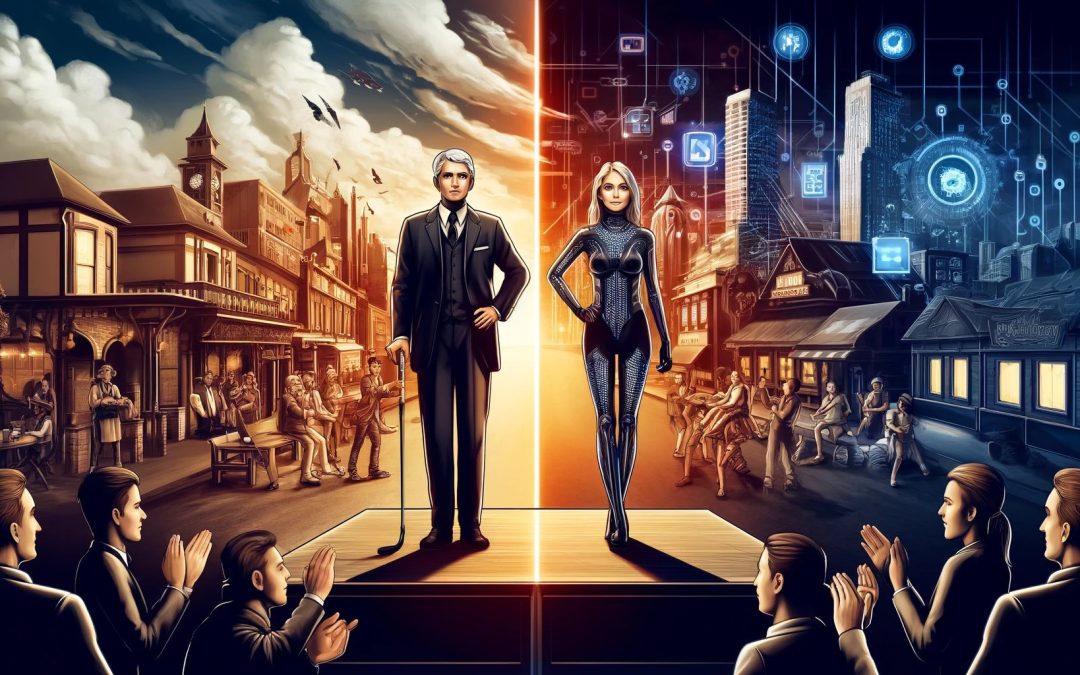
It was the final debate night. The air in the packed conference hall crackled with tension as the two candidates stood on opposite sides of the stage, glaring at each other. On one side, Martin “Marty” Dunlap, a silver-haired local businessman with the easygoing charisma of a man who had spent decades cultivating relationships over long afternoons at the golf course. He represented the “old guard”—those who believed that personal connections, handshakes, and the occasional scotch with a client were the keys to success.
Opposite him was Lydia Navarro, a sharp, forward-thinking entrepreneur who had built her digital marketing empire by leveraging the latest technologies: AI, automation, and data-driven strategies. She was the face of the new age, a symbol of the future, for better or worse.
“Ladies and gentlemen,” the moderator began, her voice trembling slightly as she stood between the two candidates. “Tonight, we’ll be discussing the future of business growth in our city and state. Mr. Dunlap, you represent a more traditional approach. Can you explain why you believe this is still the most effective way forward?”
Marty smiled broadly, leaning casually on the podium as if this were just another cocktail hour chat with old friends. “Look, I get it. Everyone’s talking about AI, algorithms, deepfakes, whatever. But when was the last time a computer closed a deal over a round of golf?” He paused, waiting for the appreciative chuckles from his supporters. “Business is about relationships. It’s about trust, and trust isn’t built by robots. You need to sit down with a person, look them in the eye, and know that they’ll have your back when times get tough.”
The old guard in the room erupted in applause, a sea of nodding heads and hearty laughs.
Lydia waited for the noise to die down, then leaned into her microphone. “Respectfully, Marty, you’re selling a past that doesn’t exist anymore. The world has changed, and so has business. Relationships matter, yes, but so does efficiency, data, and the ability to adapt. AI isn’t a replacement for people—it’s a tool to make us better. The businesses that don’t embrace technology are going to get left behind, and that’s not just my opinion. It’s fact.”
Her words were met with a loud chorus of cheers from the pro-technology side of the audience, who had been waiting for this moment. But underneath it all, the tension in the room was palpable. The divide between the two sides was deeper than any one debate could mend.
The election had taken on a life of its own in the weeks leading up to the debate. Both sides had gone to war—not just with words, but with a barrage of misinformation, dirty tricks, and outright lies.
On Marty’s side, it was the rumor mill that did most of the damage. The old-school businessmen had perfected the art of water-cooler gossip. Stories about Lydia’s “cold” and “impersonal” methods swirled in every corner of town. “You know, she once fired an entire department just because a machine told her it was more efficient,” one man would say over drinks at the local pub. “I heard she’s planning to replace half the jobs in the city with AI within the first year,” another woman whispered at her bridge club.
The rumors weren’t coming from official channels, but that didn’t stop them from spreading. It was old-fashioned word of mouth—insidious and impossible to pin down. No one could point to a single source for the accusations, but everyone seemed to have “heard” something about Lydia’s ruthless, tech-driven vision for the city. By the time the election was in full swing, many of Marty’s supporters had already made up their minds. To them, Lydia wasn’t just an opponent; she was a threat to their way of life.
Lydia, on the other hand, wasn’t about to fight gossip with more gossip. Her campaign used what they were best at—technology. A viral video surfaced just days before the debate, showing Marty making a string of inappropriate comments at a private business luncheon. Except, those who were actually there knew it hadn’t happened. It was a deepfake, an AI-generated fabrication so realistic that it fooled even a few of Marty’s closest allies—at least for a while.
But Lydia’s team didn’t stop there. Flyers circulated with doctored images of Marty shaking hands with shady foreign investors, suggesting that his old-school, off-the-record business deals were more sinister than they seemed. Lydia publicly denounced the attacks, claiming she had no part in the deepfakes, but it didn’t matter. The damage had been done.
By the time the debate rolled around, both camps had accepted that truth was just another casualty in this war. The question wasn’t who had the better ideas, but who could survive the political chaos long enough to claim victory.
As the debate wore on, it became clear that neither side was willing to give an inch. Lydia touted AI’s ability to streamline business processes, while Marty doubled down on the power of face-to-face interactions and the ‘good old boy’ network that had built the town’s economy in the first place.
Then, a question from the moderator stopped both of them in their tracks.
“How do you propose to unify a business community that is so bitterly divided?”
For a moment, there was silence. Even the audience seemed to hold its breath.
Marty spoke first, his voice steady. “We can’t ignore the fact that our town was built on relationships. You all know me. You’ve known me for years. I’ve been to your kids’ graduations, your weddings, your backyard barbecues. We’ve built this community together. Technology can help, sure, but it’s not what will hold us together. It’s personal connections, and that’s what I’m going to fight for.”
Lydia took a deep breath. “I’m not here to tear down tradition. I respect everything Marty and his generation have built, but we have to evolve. The world isn’t waiting for us to get comfortable. It’s moving fast, and if we don’t move with it, we’ll be left behind. But that doesn’t mean we can’t work together. Marty, I know you’re not against technology completely—you just need to see how it can fit into what you’re already doing.”
Marty scoffed. “Yeah, until a robot replaces me at the pub.”
The audience chuckled nervously, but Lydia didn’t back down. “No one’s replacing you, Marty. But maybe you could use some help keeping up. Golf is great, but what happens when the next generation of business owners don’t care about it? We need both strategies, and if you’re willing to meet me halfway, we can actually save this organization.”
For the first time all night, Marty didn’t have a quick comeback. The room seemed to shift. Both sides had spent so much time fighting that they hadn’t realized there might actually be common ground.
Election day arrived with a sense of anticipation, but not the usual excitement. Both camps were weary from weeks of mudslinging, and while most people had already made up their minds, there was a lingering question that no one could quite shake: Could anyone really win in this environment?
As the results came in, it became clear that the election was too close to call. Both Marty and Lydia had secured nearly equal support. In the end, it was a split decision, with neither side gaining enough of a majority to declare a clear victor. The leadership of the organization was now in question, and so was its future.
The organization didn’t implode that day, but it was clear that the battle wasn’t over. The real challenge lay ahead: finding a way to bridge the divide between the two factions and create a new path forward. Whether Marty and Lydia could find a way to work together—or if they would continue to tear each other apart—remained to be seen.







 Guest Posting

