THE SHORT VERSION Data centers are the unglamorous physical reality behind every AI response, and they consume enormous amounts of electricity and, in many cases, water. The argument worth having is not whether to build them, because you cannot have an AI economy without them, but how and where. That means siting them away from water-stressed regions when possible, requiring companies to cover the real infrastructure costs, being honest about the permanent jobs they actually create, and giving communities a genuine voice before the contracts are already signed. You can be pro-AI and still demand that the infrastructure be built responsibly. The dividing line is not progress versus resistance. It is responsible versus reckless.
There is something strange about the way most of us experience artificial intelligence. You type a question. You get an answer. You upload a document and ask for a summary. You describe an image and one appears. It feels effortless, like thinking out loud to something that listens and responds instantly. Clean. Fast. Weightless.
But it is not weightless. Not even close.
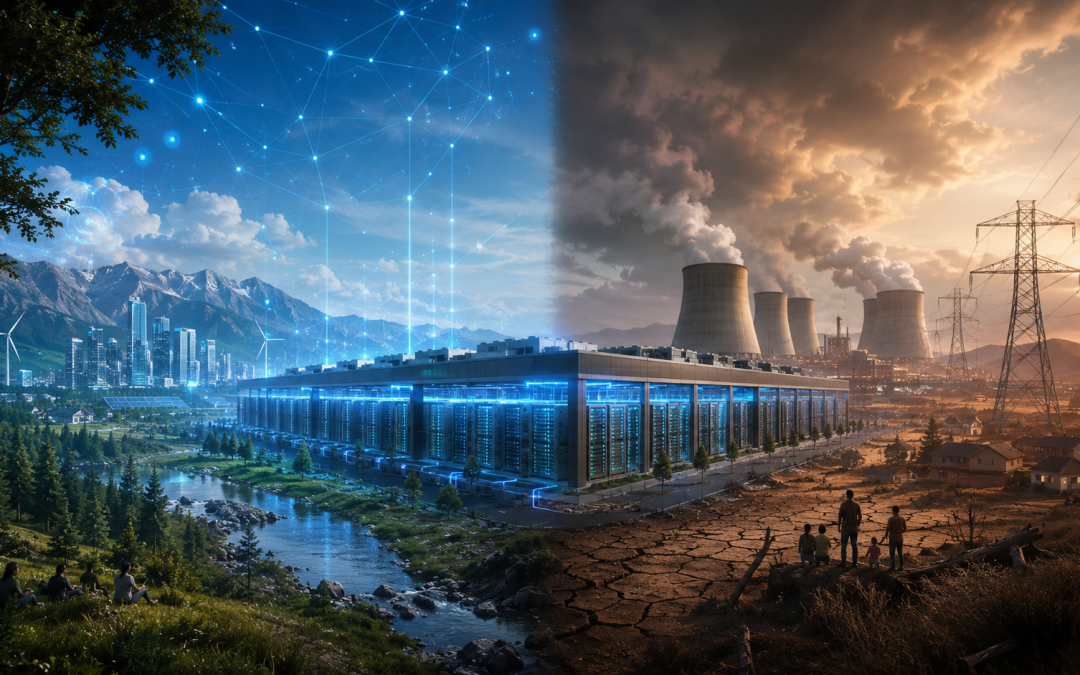
Behind every AI response is a physical building. A very large building, full of servers, cooling systems, backup generators, fiber connections, security infrastructure, concrete, steel, water, and electricity, lots of electricity. We call these buildings data centers, which is a remarkably boring name for something that is quietly becoming one of the most consequential pieces of infrastructure on the planet. The name makes them sound like a warehouse full of filing cabinets. They are not.
What they are, increasingly, is the physical engine of the AI economy. And that raises a question that most people have not really sat with yet: do we actually want the benefits of artificial intelligence badly enough to accept what it takes to make it work?
This Isn’t New, But AI Changed the Scale
Data centers were not invented for AI. Your bank uses them. Your hospital uses them. Your email, your streaming service, your GPS, your online shopping, your cloud backups, and the vast majority of the software your business runs every day, all of it lives in data centers. “The cloud” is not some magical floating thing. It is someone else’s computer, sitting in a building, drawing power from the grid.
What changed is scale, and the reason for that change is AI. Traditional cloud computing stores and retrieves information. AI doesn’t just store information, it processes it continuously, trains on enormous datasets, generates new content, analyzes images, interprets language, writes code, and responds in real time to millions of queries simultaneously. That takes a fundamentally different level of computing power than hosting a website or storing files. The International Energy Agency (IEA) reported that data center electricity demand surged in 2025, with AI-focused facilities growing even faster than data centers overall, and projects that global data center electricity consumption could more than double by 2030. So yes, AI has made this a much bigger conversation. But we built this digital world long before ChatGPT was answering questions.
The Case for Building Them
Let’s start with the honest argument in favor of data centers, because it gets lost too easily in the environmental debate.
Data centers are infrastructure. You do not get aviation without airports. You do not get electricity without power plants and transmission lines. You do not get ecommerce without warehouses, trucks, and payment networks. And you do not get AI without data centers. That is simply how it works.
More to the point, AI is not just being used to generate goofy videos or write social media captions. It is being used in medical research, drug discovery, climate modeling, fraud detection, cybersecurity, agricultural management, logistics, accessibility tools, and scientific computation. A small business owner who could never afford a full marketing or analytics team can now compete with much larger companies. A student struggling with a subject can get something close to a personalized tutor. A doctor may eventually have better diagnostic support. A researcher may be able to model complex systems in hours instead of months. These are not trivial applications, and dismissing them because some people use AI to make throwaway content misses the point entirely.
So the real question is not “are data centers bad?” It is something harder: are the benefits worth the costs, and who gets to decide what those costs should be?
The Case Against Building Them Carelessly
Here is where the conversation gets more complicated.
Data centers are resource-hungry. They use significant amounts of electricity. Many use water for cooling. They strain local power grids, sometimes requiring new substations, transmission lines, and backup infrastructure. They can change the character of a community. They generate noise. And in many cases, the long-term job numbers do not match the economic promises made during the approval process.
Communities across the country are starting to push back, and honestly, it is hard to blame them. When a data center uses local water, local land, and local grid capacity, the people who live nearby are not being unreasonable when they ask what they are getting in return. They are not anti-progress. They are the ones who have to live with the consequences of decisions that were often made without them.
The Water Question Is More Complicated Than It Sounds
One of the flashpoints in the data center debate is water. And like most things in this conversation, the truth is messier than either side usually admits.
Some data centers use water for evaporative cooling, which is often very efficient from an energy standpoint. The water absorbs heat and evaporates, carrying the heat away. What happens to that water? Technically, it returns to the Earth’s water cycle. It did not vanish from the planet. But that does not mean it returns to the same local watershed, at the same time, in the same usable form, for the same farmers or households or cities that needed it. The Environmental and Energy Study Institute has reported that some large data centers can use up to 5 million gallons of water per day, depending on size, location, and cooling design. In a water-rich region, that may not feel like a major concern. In the western United States, where farms, cities, and ecosystems are already competing fiercely for water, it becomes a very different calculation.
The honest answer is that not all data centers use water the same way. Some use air cooling with no water at all. Some use closed-loop systems that recirculate rather than evaporate. Some use treated wastewater or reclaimed water instead of drinking water. AWS, for example, says that many of its facilities use air cooling most of the year and only use evaporative cooling during hotter periods, sometimes with treated wastewater rather than potable water. Newer designs can dramatically reduce direct water use, though IEEE Spectrum has noted a tradeoff: less water often means more electricity, and more electricity may mean more indirect water use depending on how that power is generated.
So calling water use “waste” oversimplifies things, but so does saying “it all goes back into the ecosystem, so don’t worry about it.” Where the data center is located matters enormously. And that is where the planning conversation needs to happen.
The Smarter Argument Is About How, Not Whether
I think people on both sides of this debate are arguing about the wrong thing. The argument should not be “data centers are evil” or “data centers are progress so stop complaining.” Both of those positions skip the actual question.
If we are going to build these facilities, build them intelligently. Use recycled water when possible. Avoid putting them in high-water-stress areas when you have a choice. Use renewable energy where it is practical. Design for efficiency. Report energy and water usage publicly. Make companies pay for the grid and infrastructure upgrades their facilities require. And stop treating local citizens like obstacles to progress when they ask reasonable questions about what they are being asked to absorb.
None of that is anti-technology. It is just common sense.
Maybe Part of the Problem Is Us
Now here is the uncomfortable part.
We can talk about data center policy all day long, but part of the demand driving that infrastructure comes from how all of us use these tools. Every AI-generated video, image, song, summary, and fake meme requires computing power. One silly AI-generated video does not matter much. Billions of them do. And while eliminating throwaway AI content would not solve the data center problem by itself, the serious uses of AI are growing simultaneously: healthcare, education, research, manufacturing, business automation, scientific discovery. Even if every person on the planet stopped generating disposable AI content tomorrow, usage would keep climbing.
So the question worth asking is not whether we can eliminate demand, but whether we should start treating AI usage more like a resource than an unlimited buffet. That is a harder conversation, but it is also a more honest one.
The same logic applies to cloud storage. Most of us have thousands of photos, videos, files, backups, and forgotten downloads sitting in “the cloud.” But again, the cloud is not a cloud. It is a data center. It requires drives, servers, cooling systems, redundancy infrastructure, buildings, and electricity. A Stanford Magazine article made the point plainly: cloud storage has a real environmental footprint, even though it also provides real benefits. Deleting unused data and cleaning up cloud storage would not stop AI infrastructure from growing, but it would still matter. We clean out our garages. We clean out our closets. Maybe we should start treating our cloud storage the same way, not because it solves the whole problem, but because pretending that digital clutter has no cost is not honest.
The Jobs Promise Is Complicated
One of the most common arguments made to get local approval for data centers is jobs. And to be fair, they do create jobs: construction jobs, electrical jobs, HVAC, security, networking, fiber installation, and indirect economic activity from contractors and suppliers during the build. For some communities, that is significant.
But here is what often gets left out of the pitch: data centers do not employ large numbers of permanent staff relative to the amount of land, power, and water they consume. The entire point of the facility is automation and remote management. A factory might employ hundreds or thousands of workers on-site indefinitely. A large data center may require far fewer once construction is done. So the better question for a community to ask is not “will this create jobs?” but “will this create enough long-term local benefit to justify the long-term local cost?” The answer to that question will look very different in a struggling rural county than in a fast-growing city already dealing with water shortages, rising utility bills, and housing pressure.
Do Citizens Really Have a Say?
Technically, yes. There are zoning hearings, planning commissions, city councils, public comment periods, environmental reviews, and utility hearings. Citizens can petition, organize, vote, and sue.
Practically, it often feels more complicated than that. By the time most residents hear about a major data center proposal, the land is frequently already under contract, local officials have already been briefed on the economic development story, and incentive discussions may already be well underway. Public comment in that context can feel less like genuine participation and more like a formality. People get three minutes at a microphone. Developers get lobbyists, lawyers, and closed-door conversations. A recent Gallup survey found that more than 70 percent of Americans oppose data centers being built in their neighborhoods, even though most of those same people use cloud services and AI tools every day. That is the contradiction, and it is real: we want the technology, we just do not necessarily want the infrastructure next door.
Can AI Grow Without This Infrastructure?
Not the way we currently build it, no. AI needs computation. Computation needs chips. Chips need power. Power needs infrastructure. That chain has to exist somewhere.
Could AI become more efficient? Absolutely. Smaller AI models are already running locally on personal devices. More specialized models are replacing massive general-purpose ones for many tasks. Future chip designs will almost certainly reduce energy requirements. Those are real and important trends. But even with all of that progress, total demand is likely to keep growing, because we are not just making existing AI a little faster. We are embedding AI into everything: phones, cars, websites, search engines, customer service, medical imaging, robotics, education, manufacturing, logistics, and personal assistance. Every time we make AI easier to use, we create more reasons to use it. That is the paradox. Efficiency gains may reduce the energy needed for each individual task, but if usage grows fast enough, total demand can still rise. It is a bit like widening a highway to reduce traffic. Sometimes it helps, and sometimes it just invites more cars.
So Should They Be Built?
Yes. Data centers should be built. We cannot have an AI-powered economy without physical infrastructure any more than we can have an electrical grid without power plants. Pretending otherwise is not a serious position.
But not blindly, and not without accountability. Not in water-stressed regions without serious scrutiny of cooling design and water sourcing. Not with blank-check tax incentives that shift infrastructure costs onto local ratepayers. Not by overstating permanent job creation during the approval process and then delivering far less. Not by treating the communities that host these facilities as obstacles to progress when they ask perfectly reasonable questions about what they are being asked to absorb.
There is a meaningful difference between saying “we need data centers” and saying “we need this data center, in this location, on these terms, and the public should stop complaining.” The first statement may be true. The second one deserves scrutiny every single time.
You Can Be Pro-AI and Still Question How It Is Being Built
One of the problems with this debate is that people keep trying to force everyone into one of two camps: either you are cheering every new data center and billion-dollar infrastructure project as inevitable progress, or you are rejecting the whole thing as dangerous, wasteful, and harmful. That is a false choice, and it is not a very useful way to think about any powerful technology.
AI itself is morally neutral, in the same way electricity, the printing press, or the automobile are morally neutral. Billy Graham actually said it well in an article I wrote a few weeks back, where I quoted from his autobiography: “Technology is morally neutral; it is what we do with it, or fail to do with it, that makes the difference.” That was not written about AI specifically, but it fits perfectly. The real questions are who builds it, who profits from it, who pays the hidden costs, and who gets a voice before the decisions are made.
The problem is not AI. The problem is what you might call the extraction model: build fast, consume whatever resources are needed, promise innovation, and ask forgiveness after the contracts are signed. That model deserves to be challenged. But opting out entirely is not much of an answer either. If the only people shaping AI are the ones who do not care about the consequences, the future will be built by the least responsible players in the room. The dividing line worth drawing is not pro-AI versus anti-AI. It is responsible AI versus reckless AI.
This Comes Down to Responsibility
Technology companies have a responsibility to build cleaner, more efficient, more transparent facilities, and to use recycled water and renewable energy where it is genuinely feasible, not just where it makes for a good press release. Governments have a responsibility to protect water supplies, power grids, and local communities instead of rubber-stamping projects because they sound futuristic. Communities have a responsibility to ask hard questions, but also to acknowledge that modern life depends on infrastructure that has to be somewhere. And users, meaning all of us, have a responsibility to think about whether every use of AI creates enough value to justify the resources behind it.
That last one is the uncomfortable one. It is easy to talk about what corporations and governments should do differently. It is harder to look at our own habits: the endless disposable AI content, the years of forgotten backups, the cloud storage we never clean out, the AI features we use because they are there rather than because they genuinely help us.
The technology is not going away. Demand is not going down. The infrastructure will be built. The real question is whether we build it responsibly, govern it thoughtfully, and use it in ways that actually justify the cost. That is a conversation worth having, and it is one that most people are only beginning to realize is already underway.
The future of AI should not be left entirely to the companies with the biggest servers. It should also be shaped by the communities that host those servers, the workers affected by them, the businesses that depend on them, and the citizens who will live with the consequences long after the ribbon-cutting ceremony.
I would genuinely like to know what you think. Are data centers the necessary backbone of the AI economy, or an environmental and planning problem we are not taking seriously enough? Should communities have more power to say no? Should companies be required to pay more of the real cost? And are you going to clean up your cloud storage after reading this?








 Guest Posting

