
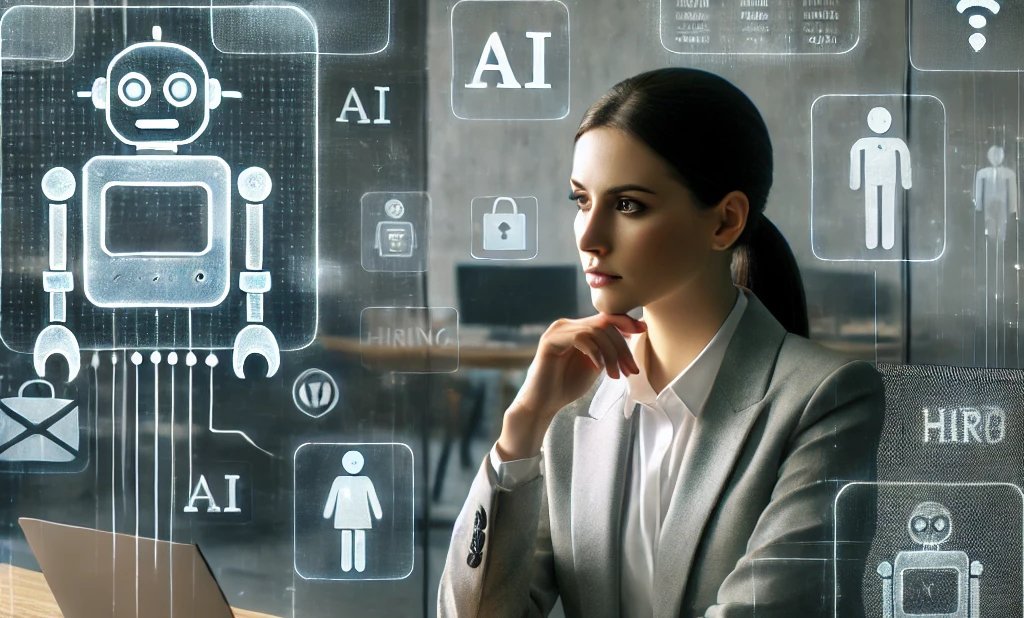
Written by AI
Margaret sat behind her desk, staring at the flickering screen of her laptop. It was a Friday afternoon, and the HR office of McKenzie Tech was quieter than usual. But Margaret’s mind buzzed, not with the noise of her colleagues, but with a much larger concern—a silent one. Her company had recently integrated a suite of AI tools into its hiring and HR processes, and what had once seemed like a futuristic leap into efficiency now felt more like walking blindfolded through a minefield.
“Margaret, you’re still here?”
She looked up to see Jason, the company’s lead procurement officer, standing in her doorway, wearing his signature grin.
“Just tying up a few things,” she said, trying to sound more relaxed than she felt. “What’s up?”
Jason wandered in, throwing himself into the chair across from her desk. “I thought I’d let you know—I found this new AI-based hiring tool that uses an algorithm to rank candidates. It’ll streamline everything! The software even analyzes video interviews for cultural fit. HR is going to love it.”
Margaret felt a knot tighten in her stomach. “Cultural fit, huh?” she muttered.
Jason blinked. “Yeah, it’s cutting-edge. They claim the algorithm can detect tone, word choice, even micro-expressions to see if someone would gel with the team. Imagine not having to second-guess interviews anymore!”
Her hands rested on the keyboard, fingers tense. “Right. Because no one ever worries about bias in those things,” she said, her voice dripping with sarcasm.
Jason chuckled, not catching on. “Oh, they’ve thought of everything. The AI’s data set is based on top performers in the industry. It’s totally fair.”
Margaret’s eyebrows rose. “Fair? Do you have any idea what kind of legal trouble we could be walking into?”
Jason’s grin faded, replaced by a puzzled expression. “Legal trouble? What are you talking about? It’s AI. It’s supposed to be neutral, right?”
Margaret sighed, rubbing her temples. “Jason, just because a system is designed by engineers doesn’t mean it’s free from human biases. If that AI ranks candidates based on patterns from past hires, and those hires were predominantly from a particular background or demographic, then we’re just codifying discrimination.”
Jason shifted in his seat. “But the vendor said it complies with all regulations—”
“And what happens when it doesn’t?” Margaret cut in. “Let’s say the AI disproportionately filters out women, or people of color. Maybe it doesn’t even realize it’s doing that. But the first time we’re hit with a lawsuit for discriminatory hiring practices, are you really going to tell the judge, ‘Oh, but the AI did it’?”
Jason opened his mouth, but Margaret wasn’t done.
“And that AI analyzing cultural fit? What if someone’s mannerisms or tone doesn’t match the ‘ideal’ candidate profile? We’re potentially sidelining excellent talent because they don’t fit into some pre-programmed box.” She leaned forward, her voice growing sharper. “It’s like hiring based on stereotypes—except now we’re outsourcing it to a machine.”
Jason’s face turned a shade paler. “I didn’t think about it like that. But surely we can rely on the vendor’s assurances, right?”
Margaret shook her head. “Vendors want to make a sale. Their guarantees are usually about functionality, not legal responsibility. It’s up to us to make sure we’re complying with employment law, not them.”
For the first time, Jason seemed genuinely concerned. “What should we do?”
Margaret exhaled slowly. “We need legal on this, Jason. And we need it yesterday.”
Later that evening, Margaret was back home, reviewing some AI-generated reports. She had another issue gnawing at her. Their latest AI-powered chatbot, ELLA, had been handling employee complaints and requests. It was great for filtering through the noise, but she’d noticed something unsettling in the logs. Some complaints—genuine, detailed ones—were being categorized as “low priority” because the AI’s natural language processing flagged them as less urgent.
She clicked through another transcript. A female employee had written in about being passed over for a promotion, mentioning her male colleague who had a less stellar track record. ELLA had responded with a generic message, something along the lines of, “Thank you for your feedback. Your issue has been noted.” Then it had filed the complaint away as a “concern about team dynamics,” and it hadn’t been escalated.
Margaret slammed the lid of her laptop shut. ELLA wasn’t just a chatbot—it was a risk. She could imagine what would happen if someone filed a lawsuit claiming the AI mishandled or ignored discrimination complaints. McKenzie Tech would be in the news, and not for its innovations.
She dialed up Sarah from the legal department.
“Sarah, it’s Margaret. We need to talk about the AI tools we’re using. I’ve spotted a few things, and I’m not sure they’re legal. At the very least, they’re unethical.”
There was a pause. “I’ve been worried about the same thing, Margaret,” Sarah admitted. “These AI systems—no one really understands what’s going on under the hood, do they? The way they’re making decisions, it’s opaque. Even the engineers don’t always know why an algorithm spits out certain results.”
Margaret sighed in relief. Finally, someone who got it. “Exactly. We’re trusting them like they’re infallible, but they’re just as flawed as the data they’re trained on.”
“Worse,” Sarah said, her voice darkening. “We can’t argue ‘unconscious bias’ when it comes to a machine. If we get sued for this, we’re wide open. There’s no grey area when you’re dealing with laws that have human protections built in. And then there’s privacy concerns—don’t even get me started on the video analysis.”
Margaret’s heart sank. “So what do we do? Pull the plug?”
“Not necessarily,” Sarah said thoughtfully. “We don’t need to go full-on Luddite. But we need transparency. If we’re going to use these AI tools, we need to understand exactly how they’re making decisions and ensure there’s a human element to review the results before any real-world impact happens. We can’t let AI have the final say.”
Margaret leaned back in her chair. “And training. Procurement folks like Jason—he’s bringing in these tools without really understanding the consequences. We need to make sure everyone involved knows the risks, and they need to be held accountable, not the machines.”
The following Monday, Margaret convened a meeting with the HR and procurement teams. Jason sat at the head of the table, noticeably quieter than usual.
“So, what’s the plan?” he asked cautiously.
Margaret tapped her fingers on the table. “We’re putting a halt to the rollout of all new AI tools until we run a full audit on each one.”
The room shifted uncomfortably.
“And,” Margaret continued, “we’re bringing in legal for every future procurement decision. No more buying shiny new toys without knowing how they work—and how they can bite us in the back.”
The group fell silent, but Margaret felt a sense of resolve settle over her. She wasn’t against AI. Not entirely. She could see its benefits. But the blind trust had to stop. AI wasn’t just software. It was a responsibility, and one misstep could land them in a world of hurt.
As the meeting wrapped up, Jason shot her a grateful glance. “Thanks for opening my eyes, Margaret.”
She smiled faintly. “Don’t thank me yet. This is just the beginning.”







 Guest Posting

