
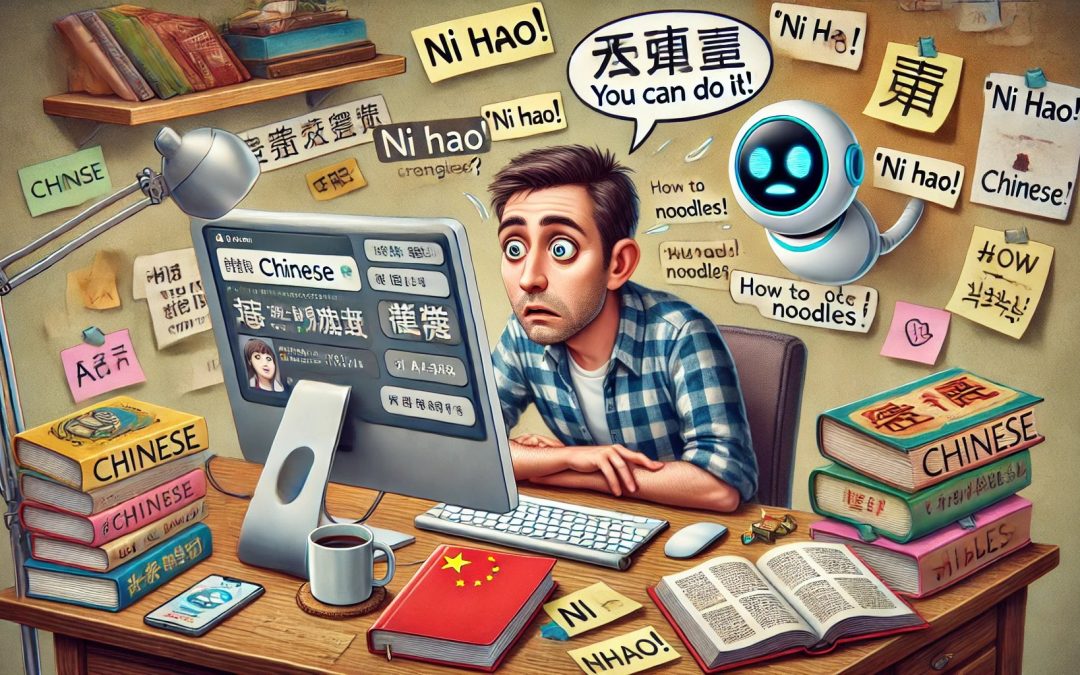
Written by AI
Martin Parsons leaned back in his squeaky office chair, staring at the blinking cursor on his screen. He scratched his head and muttered, “How on earth am I going to make an online course about…speaking Chinese? I don’t even know how to say hello.”
He glanced at the sticky note beside his monitor, which read: “AI: You don’t need to know, it does!”
It had been a bold claim from his friend Jeremy at the last networking event.
“Come on, Martin,” Jeremy had said. “With AI, you can teach anything. Build a course on Chinese. Use ChatGPT to draft lessons, then throw the script into HeyGen to make voiceovers. You don’t even need to know the language!”
The whole concept had seemed ridiculous at the time, but here he was, staring at a blank screen with only the knowledge that “ni hao” meant hello. He was about to teach Chinese. AI had gotten him through a lot before, but this? It felt like walking on the moon with a pogo stick.
Still, the prospect of creating passive income was too tempting to resist. So, he cracked his knuckles, opened up ChatGPT, and typed:
Create a 12-week course outline for learning beginner Chinese.
Within seconds, the AI produced an outline that looked surprisingly professional:
Week 1: Basic Greetings
- How to say hello, goodbye, and introduce yourself.
Week 2: Numbers and Days of the Week
- Counting and identifying the days.
Week 3: Ordering Food
- Common phrases for restaurants.
Week 4: Asking for Directions
- Basic navigation phrases.
And it went on like that, right up to Week 12, which was ambitiously titled “Engage in Basic Conversations with Native Speakers.”
Martin’s eyebrows rose. “Okay, that looks…legit,” he said to no one in particular.
Building the Course
Next, he dove into the content itself. One by one, Martin expanded each section using the AI’s suggestions. Week 1 began with greetings, so he typed:
Write a detailed lesson plan for teaching greetings in Chinese.
ChatGPT dutifully spat out a structured plan, complete with explanations of pronunciation, sample dialogues, and even homework assignments. As he read through the results, he was impressed but felt a twinge of discomfort.
“Am I really going to sell this as if I know what I’m talking about?” he asked the universe.
But that twinge quickly passed when he reminded himself he wasn’t alone in this. Everyone was using AI to fill gaps these days, right?
Once he had the scripts, he plugged them into HeyGen. It was strange hearing his own voice, digitally translated into fluent Chinese, with perfect pronunciation. He had to admit, it sounded flawless. But then came the nagging doubt again.
“Is this really me teaching? Or am I just a puppet with an AI pulling the strings?”
Martin waved the thought away and moved on to the next section. For the next two weeks, he churned out content, from basic vocabulary to restaurant phrases, with HeyGen flawlessly converting his English into Mandarin. He even added quizzes and downloadable PDFs. The course was shaping up nicely.
Still, the doubts lingered.
The Trials Begin
Martin decided it was time to beta test the course before he launched it. He sent a link to his friend Sarah, who had taken a few Mandarin classes years ago.
A few days later, they met for coffee.
“Well?” Martin asked nervously.
“It’s… interesting,” Sarah said, frowning at her cup. “The voiceovers are spot on, but…”
“But?”
“There’s something missing. I don’t know, maybe it’s because the explanations feel a little—” she paused, searching for the right word, “hollow?”
“Hollow?” Martin felt a pang of anxiety. “What do you mean?”
Sarah shrugged. “Like, the lessons are super detailed, but when you get to the exercises, it’s clear the person who wrote this doesn’t actually know what learning Chinese is like. The course gives translations, but it doesn’t break down why the language works the way it does. It’s a bit… robotic. There’s no insight, no anecdotes, none of those little quirks that an actual teacher would know.”
Martin sat back, stunned. “But AI wrote it! AI knows everything about Chinese.”
Sarah raised an eyebrow. “Does it though? It can give you correct information, but it can’t teach the experience of learning the language. There’s no human touch.”
Martin walked away from that meeting with a sour taste in his mouth. Maybe he had underestimated what it took to create a good course.
The Ethical Dilemma
That night, Martin found himself staring at his computer again, hands hovering over the keyboard. He hadn’t even considered the ethical side of this venture. Was it really fair to sell a course when he didn’t know the material himself? Was it right to rely entirely on AI for something as complex as teaching a new language?
After all, someone who knew nothing about Chinese might take his course, expecting that he, as the “teacher,” had some level of expertise. And what if they ended up confused or, worse, frustrated because they couldn’t ask real questions or dive deeper than the surface-level content AI had generated?
He imagined a student diligently working through his course, repeating phrases they learned in his lessons—phrases that Martin himself had never heard, let alone understood.
Could AI replace the expertise, intuition, and lived experience of a real teacher?
A (Slightly Humorous) Reality Check
To test the theory, Martin logged into a popular language exchange app and started chatting with a native Chinese speaker. He sent a few of the sentences from his course, hoping to get a thumbs-up.
“What does that mean?” the person typed back, confused.
Martin’s face went pale. “It means ‘I would like to order noodles,’ doesn’t it?”
A pause. Then, the reply: “No. You just asked for someone to ‘give you a face.’ Which… isn’t a thing.”
Martin’s heart sank. Maybe AI had gotten some of it wrong.
The Conclusion
In the end, Martin decided to do the ethical thing. He didn’t scrap the course entirely, but he changed the way he marketed it. He clearly labeled it as a “beginner’s guide powered by AI,” adding disclaimers that it was best suited as an additional resource, not a replacement for formal learning or professional instruction.
He also made the price more modest, reflecting the limitations of what the course could offer.
It sold reasonably well, but more importantly, Martin felt at peace with how he had handled it. AI could be a powerful tool, but it couldn’t fully replace human knowledge, experience, and that essential ability to improvise and adapt to a learner’s needs.
Epilogue
Months later, Martin was having coffee with Jeremy again.
“So, how did the Chinese course thing go?” Jeremy asked, sipping his latte.
“Well,” Martin said, “I made some money. But more importantly, I learned that just because you can teach something using AI, doesn’t mean you should.”
Jeremy snorted. “Oh, so you’re a philosopher now.”
“Something like that,” Martin said with a grin. “And I learned how to properly order noodles.”








 Guest Posting

