
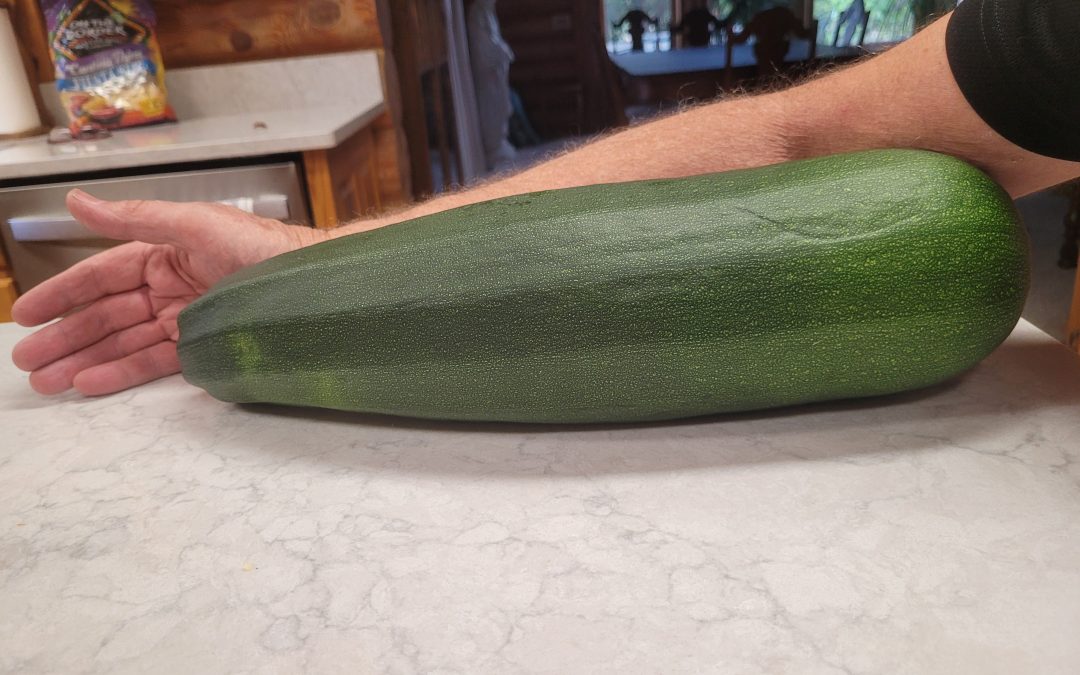
When my cousin-in-law handed me a zucchini the size of my forearm, she laughed and said, “You should put this in your newsletter.” That was the real challenge—not baking the bread, but figuring out how to tie a giant squash into a conversation about AI and ecommerce.
So I did what anyone would do in my situation: I grated it up and made zucchini bread. But as I worked, I realized the parallels were almost too perfect. A zucchini that big is exciting, but also overwhelming. Too much of it ruins the recipe, too little and you barely notice it. The art is in balance.
And that’s exactly how AI works. Everyone’s got data. Some people have more than they know what to do with. But data, like a giant zucchini, doesn’t magically turn into something useful just because you’ve got a lot of it lying around. You need a recipe. You need a process. And you need to know which parts to use and which parts to toss.
That’s when it hit me: zucchini bread and AI have more in common than you’d think.
The Raw Ingredients
Let’s start with the obvious: the zucchini itself. This is your raw material. For AI, the zucchini is data. And like a zucchini, data comes in all shapes and sizes. Some of it is fresh, some of it is stale, some of it is perfect for baking, and some of it is watery mush.
If you try to throw the whole zucchini into a mixer, you’re going to break the blades. Same thing if you dump all your raw data into an AI without preparing it. Data has to be shredded, just like zucchini has to be grated.
Shredding is the preprocessing step. You’re breaking down raw information into a form that can be mixed into the recipe. That might mean cleaning your spreadsheets, standardizing your formats, or labeling images so your AI knows what’s what. Just like with zucchini, if you don’t do this prep work, the recipe is doomed from the start.
Garbage In, Garbage Out
Now here’s another important thing: not all zucchini is worth baking with. If it’s too old, filled with seeds, or watery, your bread is going to come out dense and tasteless.
AI has the same rule: garbage in, garbage out. If your data is messy, biased, or irrelevant, your AI will give you bad answers. That’s not because AI “failed,” it’s because you didn’t feed it properly.
Think about it this way. If you use customer service transcripts to train an AI chatbot, but half of those transcripts are filled with typos, sarcasm, or irrelevant side chatter, your AI is going to “learn” all of that. Then when it answers your customers, it won’t sound polished—it’ll sound like the raw zucchini you never should have grated in the first place.
The Recipe
A recipe is a framework. It gives structure to what you’re trying to accomplish. In baking, that recipe balances flour, sugar, eggs, spices, and of course zucchini. In AI, the recipe is your workflow:
What problem are you solving?
What type of model are you using?
How do you balance speed, accuracy, and cost?
Without a recipe, you’re just guessing. And you might still get bread, but it won’t taste good. That’s what happens when businesses jump into AI without a plan. They throw some data at ChatGPT, ask it for a report, and then wonder why the result doesn’t make sense.
But if you follow a proven recipe, you can replicate success every time.
The Secret Ingredients
Here’s the part I love: zucchini bread isn’t just flour, sugar, and zucchini. It has spices—cinnamon, nutmeg, maybe even a splash of vanilla. Some people add nuts, raisins, or chocolate chips. These little touches are what make your bread memorable.
The same thing applies to AI. Everyone has access to large language models now. Everyone can run prompts. What makes your business stand out is the “secret spice” you add. That might be:
Proprietary customer data that only you have.
A fine-tuned model that speaks in your brand’s voice.
A unique workflow that solves a problem better than anyone else.
Those little touches are the difference between ordinary and extraordinary. Between another generic AI chatbot and one that actually drives sales. Between bland zucchini bread and the loaf everyone begs you to bring to the potluck.
Scaling the Recipe
When you make zucchini bread at home, you’re usually working with one or two cups of shredded zucchini. But what happens when someone gives you a zucchini the size of a baseball bat? You either scale up the recipe, or you waste a lot of raw material.
This is the same challenge businesses face with AI. If you’ve only got a little data, you can make a small batch solution. But when you’ve got massive datasets—millions of customer interactions, terabytes of sales history—you need a recipe that scales.
Scaling in AI means:
More powerful infrastructure (cloud servers, GPUs).
Smarter preprocessing so you don’t choke on raw inputs.
Better workflows to handle volume without losing quality.
If you don’t scale the recipe, you end up with waste. Just like I’d end up with half a zucchini rotting in the fridge if I only made one loaf.
AI as the Oven
The oven is where the magic happens. You can have the freshest zucchini, the best flour, and the right spices, but if your oven isn’t set properly, the bread won’t rise. Too hot, and it burns. Too cool, and it comes out soggy.
AI is the oven. It’s the tool that transforms raw ingredients into something new. But here’s the catch: the oven doesn’t care what you put in it. If your recipe is wrong, the oven will faithfully bake a bad loaf.
This is where people misunderstand AI. They think the oven will fix the recipe. It won’t. AI doesn’t create value on its own—it amplifies what you give it. Good inputs and a good recipe produce great results. Bad inputs and no recipe produce disasters faster than ever.
Lessons for Business
So what can zucchini bread teach us about AI? Quite a lot, actually. Here are the key takeaways:
Start with good ingredients. Clean, relevant, high-quality data is the foundation of every good AI project.
Shred and prep before mixing. Raw data needs processing, just like zucchini needs grating.
Follow a recipe. Frameworks and workflows matter. You need a plan, not just enthusiasm.
Add your secret spice. Proprietary data, unique workflows, and brand voice are what make your AI stand out.
Use the oven wisely. AI doesn’t fix bad recipes, it only amplifies them.
Scale thoughtfully. Big zucchinis (and big datasets) require scaling the recipe, not just doubling ingredients blindly.
A Story Worth Sharing
When I pulled that zucchini bread out of the oven, my kitchen smelled amazing. I had taken a vegetable most people ignore once it gets too big and turned it into something worth sharing. That’s what AI can do with your business data.
You might feel overwhelmed by how much information you have, or how messy it looks, or how big the challenge feels. But with the right recipe, you can transform it into something valuable, something your customers will appreciate, and something that sets you apart.
The Bigger Picture
Here’s the real kicker: zucchini bread is seasonal. You only make it when someone’s garden explodes and they have more squash than they can eat. But AI isn’t seasonal. It’s here all the time. Businesses that treat AI like a once-in-a-while experiment are missing the point.
AI should be part of your kitchen. A tool you use regularly, not just when someone hands you a giant zucchini. That’s when you start to see real transformation—when AI isn’t just a novelty, but a core part of how you operate.
Your Turn
So now I’ll throw the challenge back to you.
What zucchinis are sitting on your counter? In other words, what raw data do you have that’s just waiting to be turned into something valuable? Maybe it’s customer support transcripts. Maybe it’s sales data. Maybe it’s the questions people keep asking you over email.
Don’t let those zucchinis go bad. Shred them, spice them, and put them in the oven. With the right recipe, you’ll create something worth sharing.
And here’s the best part: just like zucchini bread can be sold at a farmer’s market, AI can be used to create revenue streams you didn’t even know existed. Whether it’s new digital products, personalized services, or entire business models, AI is the bridge between the raw ingredients you already have and the financial results you want.
Call to Action
If you want to learn how to make your own version of AI zucchini bread, let’s talk. Schedule a consult, grab my book Bluff, or join my mastermind group where we swap recipes for using AI in ways that actually grow your business.
Because the truth is, AI isn’t about replacing human effort. It’s about amplifying human potential. And sometimes, it’s about turning a giant zucchini into something unforgettable.








 Guest Posting

