
By Jason Khoo
Businesses have always had to adapt to changes in the world, and that includes shifting content strategies according to new tech. Search engine optimization (SEO) is one of the most important ways for modern brands to make sure that their content is seen and ranked high in search, and even tactics from even a few years ago that would normally get you decent Google rankings have now been replaced or completely updated.
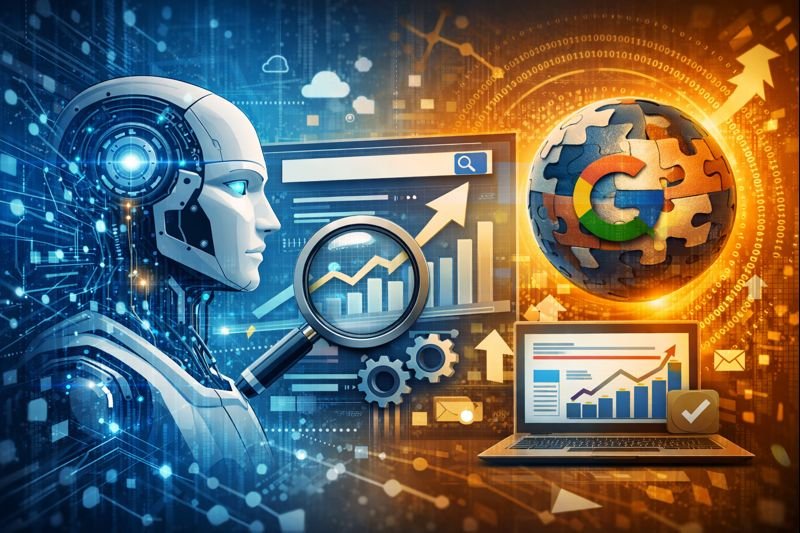
AI-generated answers and summaries are becoming increasingly popular across the board, and this means that SEO strategists must adapt. Companies need to restructure and maybe even rewrite their content in a way that can be read by artificial intelligence. Google is especially known for changing how its algorithms work, and it can be difficult for companies to catch up if they are not tactical. Below, we discuss how to best adapt your SEO to the ever-changing algorithms that Google uses.
AI and Google Search Algorithms
When search engines were first introduced, the algorithms behind them were simple but also did not result in the most accurate results. As the companies that run these search engines have improved the accuracy of their query results, the algorithms have naturally become much more sophisticated.
Before AI, search engine algorithms mainly focused on matching keyword placement in order to provide relevant results. Modern search engines now rely on a range of emerging AI technologies. Some of the most prominent examples include semantic search, natural language processing (NLP), large language models (LLMs), and machine learning (ML).
As the most popular search engine in the world, Google has been dedicated to using these new AI technologies to improve their search results and summaries. Just over a decade ago, in 2015, Google introduced an AI-powered solution called RankBrain that would shift search engine rankings. Over the next seven years, they additionally implemented Bidirectional Encoder Representations from Transformers (BERT) and the Multitask Unified Model (MUM) to guide their algorithms.
Each major improvement in AI-powered tech means that Google has more sophisticated capabilities as a search engine. However, these massive shifts also mean that the variables that affect search engine rankings are also always changing and businesses must adapt their SEO strategies to reflect the current tech.
Adapting Your SEO for AI Visibility
AI visibility refers to a brand’s presence within search results and summaries generated by artificial intelligence software, and companies need to adapt their SEO strategies to improve this new factor. Content quality, user experience (UX), and technical SEO are three of the most prominent areas in which brands can usually rework their content to become more visible to emerging AI technologies.
Content Quality
Content quality is the best way to improve your content for AI visibility is to improve its quality. In fact, Google published its own unique framework content quality called E-E-A-T, which stands for experience, expertise, authoritativeness, and trustworthiness. This means that content that is clearly written by a creator with these qualities will rank more highly in Google rankings.
Google’s rankings emphasize content that is extensively researched and supported, accurate, and written by content creators that have expertise in the specific industry or subject matter being searched. Newer AI technologies are trained to separate articles that meet these standards from those who don’t.
UX
User experience (UX) is an important and related aspect to keep in mind while designing your SEO strategy. Newer algorithms will more highly rank results that are relevant, current, and have high performance metrics over content that is deemed irrelevant, outdated, and has poor performance-based metrics.
Bounce rate is one of the most important metrics for Google’s algorithms, and a high bounce rate means that users are not actively engaging with the on-page content to remain on the site. If you make significant improvements to your site’s structure, performance, and navigation system, you can get a better bounce rate and thus a higher spot on the search engine results page.
Technical SEO
Technical SEO has always been a key part of SEO strategies, but it is even more relevant with the newest algorithms. The quality of the writing should be high, as we mentioned above, but it also has to be formatted in such a way that users can quickly and easily access the information they need.
Making sure that information is formatted properly will also let AI-generated search engines be able to easily read and summarize your content. Use structured data markup or schema markup to categorize your content so that your site can be easily indexed by search engines. You can also use top GEO, AEO, or AI visibility agencies to help rework your content.
Adapting to Future AI Trends
Personalized Search Outcomes
One of the newest ways AI is going to revolutionize search will be personalizing search outcomes for each user. Once the language processing capability of emerging AI tech gets to a certain point, Google and other popular search engines will be able to fully get what users are actually looking for when they type in certain queries. Factors like a user’s past search history, online behaviors, and even location will be utilized so that results are not just reflecting keyword choices.
Zero-Click Searches
Zero-click searches refer to when a user is able to find the answer to their query on a search engine without having to click a single link. AI overviews and other related AI-driven search results look through all of the top search results for you and give you a summarized answer to whatever you searched. Website owners who are not seeing as much organic search traffic can rework their content so that answers to popular queries are succinctly written and easy to spot without navigating through multiple SERP links.
Conversational AI
Conversational AI assistants like Google Gemini, Alexa, and Siri are also becoming widely used, and their users will often ask them questions instead of just typing them into their phones or laptops. Marketing teams need to take this into consideration when devising SEO strategies so that content is written in style that still feels like the water a human reader would speak and digest new information (in addition to being formatted so that AI-enhanced search engines can digest and summarize said info).
Conclusion
AI-powered and AI-enhanced technologies are pivotal to large search engines like Google, and the goal here is to make improvements to the user’s search experience. These new advancements in tech do mean though that there are always new algorithms to contend with when marketing your sites and the content within them.
Your SEO strategy needs to be adapted to the latest algorithm shifts that these AI technologies have created. Do whatever you can to rework old content or write new content that takes into account high content quality, high UX, and technical SEO. Fitting these and any new trends will help ensure that your content continues to experience organic growth and high search results rankings.
 Jason Khoo started freelancing in SEO in college, sold his first agency, and now is the founder of Zupo, an Orange County-based SEO consulting agency helping construct powerful long-term SEO strategies for our clients. Jason also enjoys multiple cups of tea daily, hiding away on weekends, catching up on reading, and rewatching The Simpsons for the 20th time.







 Guest Posting

