

TL;DR:
|
There is a certain kind of confidence that only comes from being completely wrong.
In 2016, Geoffrey Hinton stood on a stage in Toronto and made a pronouncement that rattled an entire medical profession. Hinton was not some casual observer. He is widely called the “Godfather of AI,” a researcher whose foundational work on neural networks essentially made modern artificial intelligence possible. He later won the Nobel Prize in Physics for it. When Geoffrey Hinton speaks about AI, people listen.
What he said was this: “If you work as a radiologist, you are like the coyote that’s already over the edge of the cliff but hasn’t yet looked down.” He went further. “People should stop training radiologists now. It’s just completely obvious that within five years deep learning is going to do better than radiologists.”
Medical schools took notice. Enrollment in radiology residencies softened. Why spend a decade in training for a career that a Nobel laureate had declared was already over?
Fast forward to 2026. The average radiologist salary has climbed to $571,000 a year, up 9 percent from the year before. There are more than 4,000 open radiologist positions in the United States, and they are taking an average of 130 days to fill. The Mayo Clinic’s radiology department has grown by 55 percent since Hinton made his prediction. The American College of Radiology is forecasting that the specialty will add another 26 percent more physicians over the next 30 years.
Hinton acknowledged the error in 2025. He said he spoke too broadly, that he was only really talking about image analysis, and that he was wrong about the timing. He now believes the future of radiology will be a combination of AI and physicians working together, making radiologists more efficient rather than replacing them.
Which is, of course, exactly what most radiologists had been saying all along.
I find this story interesting not because Hinton was wrong, but because of who else was wrong right alongside him. The people who dismissed AI entirely, the ones who said it would never touch a radiologist’s job, were also missing the point. What actually happened was more nuanced and more useful than either camp predicted. AI is now in active use in radiology departments around the world, sharpening images, flagging anomalies, handling the routine so physicians can focus on the complex. The demand for radiologists didn’t go away. It went up, partly because AI-assisted imaging became faster and cheaper and therefore more widely ordered.
The technology did exactly what useful technology tends to do. It amplified the humans rather than replacing them.
This is not the first time smart people have gotten this wrong, and I suspect it will not be the last. The history of technology is littered with confident predictions that turned out to be spectacular nonsense, usually made by serious, credentialed people who were looking directly at the evidence and still drawing the wrong conclusion.
In 1876, Western Union’s internal memo dismissed Alexander Graham Bell’s telephone as having “too many shortcomings to be seriously considered as a means of communication.” Today there are more phone subscriptions on Earth than there are people. In 1903, the New York Times estimated it would take between one million and ten million years before human beings achieved powered flight. The Wright brothers flew sixty-nine days later. In 1943, IBM’s chairman Thomas Watson is reported to have said he thought there was a world market for maybe five computers. There are now billions of them, and you probably have one in your pocket right now.
What strikes me about these predictions is not just that they were wrong, but how they were wrong. The people making them were usually looking at the correct evidence. Western Union understood telecommunications. Thomas Watson ran the most powerful computing company in the world. Geoffrey Hinton literally invented the technology he was predicting. The error was never really about the facts. It was about the question they were asking.
They were asking: “Is this thing impressive enough right now to matter?”
The better question is always: “What does this become?”
I have had a front-row seat to a few of these transitions myself. When I was working in the AutoCAD world in the 1980s, building LANDCADD into the leading landscape architecture software, there was genuine argument in the profession about whether computers would ever replace the drafting table. Serious practitioners made the case that hand drawing required a kind of spatial understanding that a machine could never replicate. They were not wrong about hand drawing. They were wrong about the question. The question was never whether computers could replicate drafting. It was whether computers could make the whole design process faster, more precise, and more powerful. They could, and they did, and the people who adapted to that reality thrived.
The same dynamic is playing out with AI right now, and the mistakes are remarkably familiar. On one side you have people declaring that AI will replace doctors, lawyers, writers, programmers, teachers, and frankly most of the workforce within the next few years. On the other side you have people pointing to the hallucinations, the fabricated citations, the occasional bizarre image with extra fingers, and concluding that AI is mostly hype and will soon be forgotten. Both camps are asking the wrong question.
What actually matters is how the technology develops over the next decade, what it gets woven into, and whether the people and businesses using it are doing so with any genuine intelligence. The Hinton story is instructive precisely because the resolution was not what either side predicted. AI did not kill radiology. AI did not prove to be irrelevant to radiology. AI became a tool that made good radiologists better, increased demand for the specialty, and left the professionals who understood both medicine and technology in a stronger position than they were before.
My father, a Range Science professor who let me experiment with his research computer when I was a teenager, had a joke about artificial intelligence. He would tell me that artificial intelligence is only for those who don’t have any real intelligence. He was teasing, mostly. But I think about that line when I see businesses either panicking about AI or dismissing it entirely, because both responses are, in their own way, a failure of real intelligence.
The businesses that will benefit from AI are not the ones handing their creativity and judgment over to a machine and calling it a strategy. They are the ones asking the better question: what does this become, how does it fit into what I already do well, and how do I use it to serve my customers in ways I couldn’t before?
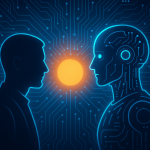
That is where Geoffrey Hinton actually landed, once he had a chance to correct his prediction. Not “AI replaces radiologists.” Not “AI is irrelevant to radiology.” But “AI and radiologists together will be better than either one alone.”





 Guest Posting

