
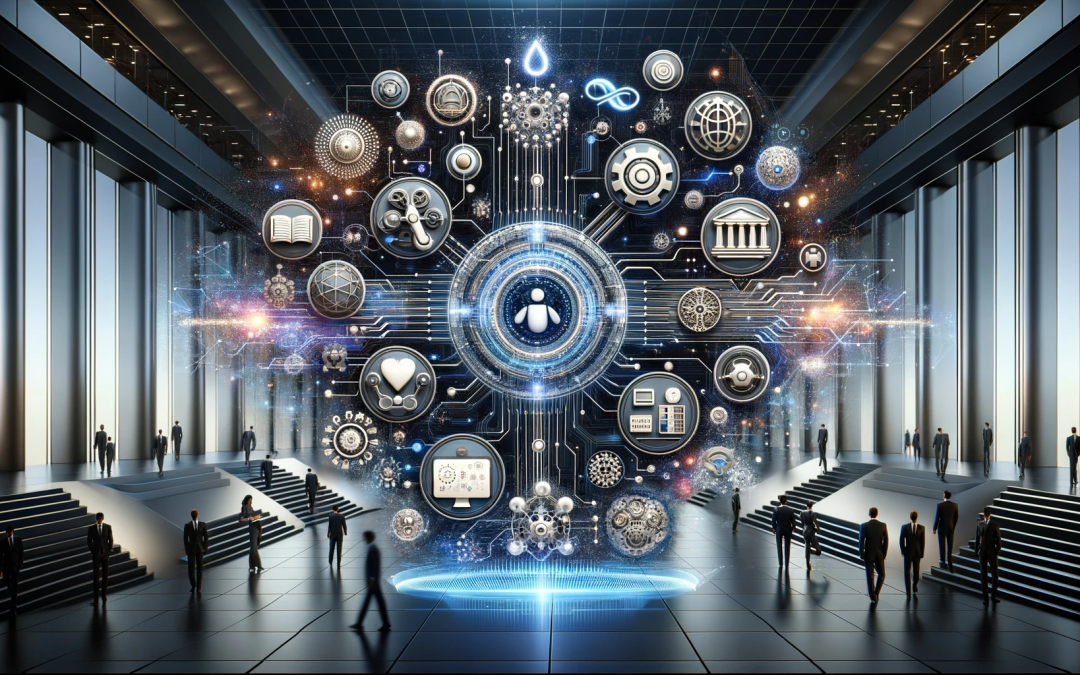
When we think about AI, most people think about ChatGPT. Which is understandable, since ChatGPT is the platform that is most often talked about in the news. But ChatGPT is only a small fraction of AI.
In the last decade, Artificial Intelligence (AI) has leaped from academic research to a driving force in our daily lives. From the AI in our smartphones to autonomous vehicles, the technology’s rapid evolution promises even more groundbreaking advancements in the near future. As we stand at the threshold of another year, let’s explore the current state of AI across its diverse branches and speculate on what the next year might hold for this dynamic field.
Machine Learning (ML), especially deep learning, is at the core of today’s AI advancements. But Artificial Intelligence (AI) encompasses several branches beyond machine learning, each with its unique focus and methodologies. Here are some of the key branches:

Machine Learning: The Heartbeat of Modern AI
This branch focuses on developing algorithms and statistical models that enable computers to perform tasks without explicit instructions, relying on patterns and inference. It includes deep learning and neural networks. Google’s AlphaGo is a prime example, showcasing the potential of ML in mastering complex tasks. In the next year, expect ML to make strides in efficiency and accessibility, allowing more businesses to leverage its power.
Natural Language Processing: Bridging Human-AI Communication
NLP is concerned with enabling computers to understand, interpret, and respond to human language in a meaningful way. It involves tasks like language translation, sentiment analysis, and chatbots. NLP has been a game-changer, with systems like IBM Watson leading the way. ChatGPT, which combines NLP and ML, represents the pinnacle of this technology, enabling intuitive human-computer interactions. The coming year will likely see NLP becoming even more sophisticated, with improved context understanding and multilingual capabilities.
Robotics: The Physical Extension of AI
This field involves the design, construction, operation, and use of robots, often integrating other AI branches like ML and computer vision to enable autonomous or semi-autonomous behavior. Robotics, exemplified by Boston Dynamics, has moved from industrial applications to more public domains. The integration of AI into robotics is making them more autonomous and capable. In the next year, expect to see robots becoming more adaptable to varied environments and tasks.
Computer Vision: AI’s Eyes to the World
This branch focuses on enabling computers to interpret and make decisions based on visual data from the real world. Applications include image and video recognition, facial recognition, and object detection. Apple’s Face ID technology highlights the advances in computer vision. This branch will continue to evolve, with potential improvements in facial recognition algorithms and privacy-preserving techniques in the next year.
Expert Systems: AI as Decision-Makers
These are computer systems that emulate the decision-making ability of a human expert. They use a set of rules to analyze information and make conclusions, often used in domains like medical diagnosis and legal advice. The early work I did with irrigation design could be classified as an expert system. While not as flashy as other AI technologies, expert systems like MYCIN play critical roles in specialized areas such as medical diagnosis. The coming year may see these systems becoming more widespread in industries like law and finance.
Speech Recognition: Listening and Understanding
This area focuses on enabling computers to recognize and interpret human speech. It’s widely used in virtual assistants, voice-operated devices, and transcription services. Amazon Alexa represents how far speech recognition has come. Future advancements might focus on reducing biases in speech recognition systems and enhancing their ability to understand diverse accents and dialects.
Planning and Scheduling: AI as Organizers
This branch involves creating algorithms that enable systems to plan actions or make schedules. It’s crucial in logistics, supply chain management, and automated digital assistants. Autonomous vehicles and smart manufacturing use AI for efficient planning. The next year could see these systems becoming more anticipatory, making decisions based on predictive models.
Knowledge Representation: AI as Knowers
This field is about representing information about the world in a form that a computer system can utilize to solve complex tasks like diagnosing a medical condition or having a dialog in natural language. Wolfram Alpha showcases AI’s ability to process and utilize vast knowledge. The next year could see these systems becoming more integrated into educational and research-based platforms.






 Guest Posting

