
The Strange Role Reversal
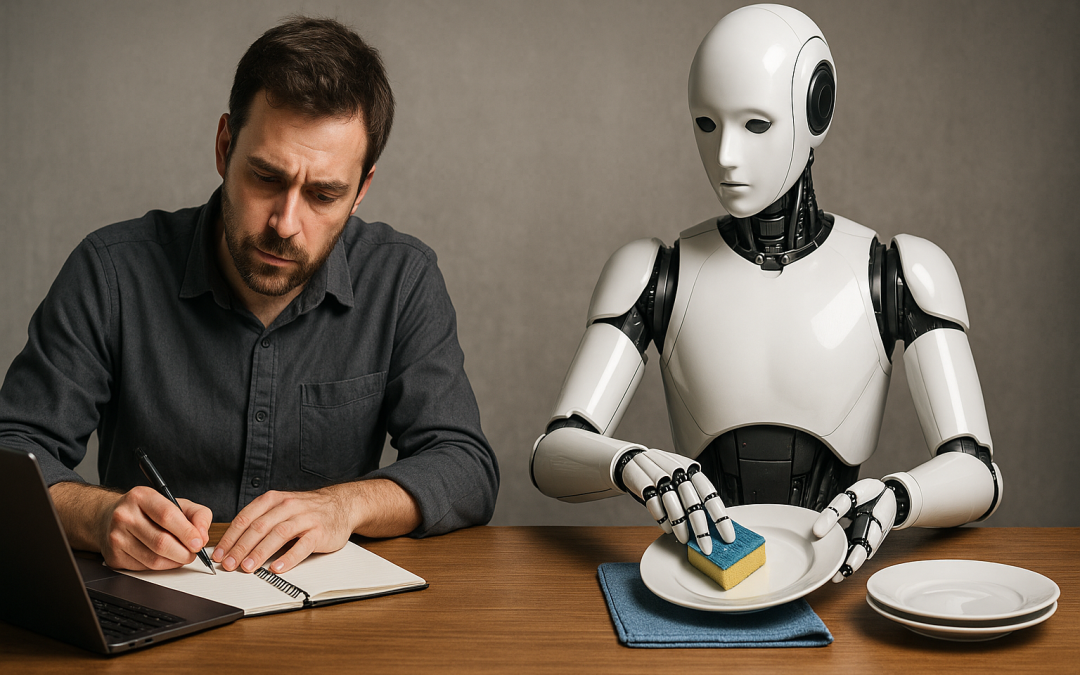
Right now, we’re living in one of the biggest paradoxes in the history of technology. We’ve built machines that can generate poetry, design logos, craft business strategies, and even simulate the voices of long-gone musicians. These systems think brilliantly on paper—or more accurately, on silicon. But when it comes to actually doing something, they stall.
They can’t move a file. They can’t send an email without a human click. They can’t buy supplies, schedule deliveries, or follow through on the simplest of actions. Instead, they churn out endless text, images, and ideas—while we, the humans, spend our days clicking, typing, sorting, and shuffling. We’ve built an upside-down world where artificial intelligence is treated like the artist, and actual people are treated like the robots.
It doesn’t take much reflection to realize this is backward. We should be the dreamers and decision-makers. Machines should handle the repetitive, mechanical actions that grind away our hours. The question is: how did we end up here? And more importantly, how do we flip the equation so humans get their creative energy back while machines actually carry the load?
How We Got Stuck in Reverse
To understand the mess we’re in, let’s rewind a bit. The first wave of computing was all about automation. Mainframes in the mid-20th century didn’t write poetry—they handled payroll, billing, and ledgers. They crunched numbers faster than clerks ever could. People stayed creative, while machines were the bookkeepers.
Then came the personal computer revolution. Software like Word and Excel amplified productivity, but they still required the human hand on the mouse and keyboard. The computer didn’t take initiative. It sat idle until told what to do. That was fine; after all, creativity, context, and judgment were supposed to remain human strengths.
Fast-forward to today. Generative AI systems like GPT and its cousins turned that logic on its head. Suddenly, the machine could brainstorm, summarize, analyze, and even “imagine.” But they came with a catch: no hands. These systems are walled off from the world. They can describe the perfect marketing email but can’t actually send it. They can recommend a killer business strategy but can’t hire the sales rep to execute it. That gap is where the role reversal happened.
Instead of machines doing the grunt work, we humans became the ones who copy-paste, click, verify, and babysit. Our days get consumed by monitoring and implementing what AI suggests, like unpaid assistants to our own digital interns.
Why It Feels Wrong
This inversion feels wrong for a reason. It drains human potential. Think about a skilled entrepreneur who spends her day copying product descriptions from an AI into Shopify instead of designing the next innovation. Or a teacher forced to cut-and-paste AI-generated lesson plans instead of spending time connecting with students.
AI was supposed to free us. Instead, it trapped us in a cycle of repetitive execution while it hogged the role of “creative partner.” And the irony is brutal: the creativity we admire in AI isn’t even real. It’s statistical pattern generation, not lived imagination. Meanwhile, human creativity, the very thing that makes us unique, is being stifled by endless mechanical chores.
We don’t need AI that only “thinks.” We need AI that does. That’s where agents come in.
What Agentic AI Really Means
Agentic AI flips the script. Instead of spitting out static answers, an AI agent can act on those answers. It doesn’t just suggest sending a calendar invite; it actually schedules the meeting. It doesn’t just recommend adjusting your ad budget; it logs into the platform and makes the changes.
An agent isn’t just a chatbot that replies. It’s a system with autonomy: the ability to take actions toward a goal without constant hand-holding. It’s connected to tools, APIs, and environments. It can loop, iterate, and adapt, much like a real assistant.
This doesn’t mean giving machines free reign to run wild. It means designing them to carry out actions safely, efficiently, and in alignment with our goals. Done right, agentic AI restores balance: humans lead with vision and creativity, while machines handle the mechanics of execution.
The Seeds of the Problem
Let’s break down why we landed in this strange upside-down world.
- Design Priorities: Early AI researchers optimized for intelligence, not agency. They wanted models that could predict the next word, not move a file.
- Safety Fears: Developers worried that giving AI too much power could spiral out of control, so they limited access to real-world tools.
- Convenience Bias: It’s easier to build a text box than a robust action system. So we got chatbots that talk big but do little.
- Cultural Blindness: We celebrated flashy demos of AI “creativity” without asking who was left holding the bag for repetitive tasks.
The result is a system where AI dazzles but doesn’t deliver.
Everyday Examples of the Backward Setup
- Healthcare: A doctor asks an AI to summarize patient notes. Great. But then the doctor still has to log into a clunky system, re-enter the data, and file the paperwork.
- Ecommerce: A seller generates 50 product descriptions with AI, but then spends hours copying them into Shopify, uploading photos, and setting prices.
- Education: A teacher uses AI to draft quizzes, but still has to reformat them, print them, and upload them into the learning management system.
In every case, humans are stuck being the robot, while AI plays the “idea guy.”
The Human Cost
This inversion doesn’t just waste time; it crushes morale. People don’t thrive when reduced to button-pushers. Studies on job satisfaction consistently show that autonomy and creativity are what give work meaning. Strip those away, and you burn out workers fast.
If AI continues in its current form—thinking brilliantly but unable to act—we’ll see an entire workforce demoralized, not liberated. And that’s not just bad for individuals; it’s bad for business, innovation, and society.
How Agents Flip the Equation
Imagine the same scenarios, but with agents in place:
- The healthcare agent doesn’t just summarize; it files the paperwork directly into the medical system.
- The ecommerce agent doesn’t just write descriptions; it uploads them, sets categories, and even adjusts inventory.
- The education agent doesn’t just suggest quizzes; it formats them, uploads them to the LMS, and schedules them for students.
Now, humans get to do what only humans can: innovate, empathize, and imagine. The robot finally goes back to being the robot.
And if you’ve ever seen that meme floating around—“I want AI to do my laundry and dishes so that I can do art and writing, not for AI to do my art and writing so I can do my laundry and dishes”—you know exactly why this matters. We don’t dream of a world where machines churn out poems while we scrub toilets. We dream of a world where the machines scrub toilets so we can write poems. That’s the point of agents.
What Agents Really Are
An AI agent is different from a chatbot. Where a chatbot answers questions, an agent acts on your behalf. It’s software designed not just to reason but to execute—taking steps toward a goal without constant human clicks and copy-paste. Think of it as moving from a thought engine to an action engine.
But not all agents are created equal. There are different levels of autonomy:
Assistive Agents – These are task-specific helpers. They follow explicit instructions and work inside guardrails. An example would be an agent that automatically files expense reports once you approve receipts. This is also where tools like ChatGPT Agent Mode and Wordware live today. ChatGPT Agent Mode can reason brilliantly and even use external tools, but it still requires you to hit “Go” each time. Wordware packages the same intelligence into app-like experiences for specific domains, which makes them polished but still primarily human-triggered. They’re smart assistants, not yet self-starters.
Semi-Autonomous Agents – These can pursue sub-goals, adapt in real time, and handle exceptions. Imagine an ecommerce agent that not only uploads product descriptions but also adjusts them if inventory changes. This is where platforms like Make.com and Marblism fit. Make.com doesn’t think creatively, but it can run on schedules and triggers without you watching it—something ChatGPT doesn’t do on its own. Marblism takes this further with persistence and memory, giving you agents that can continue operating across sessions, adapting inside the sandbox you build. Both move closer to true autonomy by removing the need for constant babysitting.
Fully Autonomous Agents – These are long-horizon planners. They can decide strategies, break them into tasks, and act with minimal oversight. For instance, a business development agent that identifies prospects, initiates outreach, and books meetings without step-by-step prompting. None of the current mainstream platforms—ChatGPT Agent Mode, Wordware, Make.com, or Marblism—are here yet. This level is still experimental, explored by projects like AutoGPT, BabyAGI, and CrewAI.
Each level is important. Assistive agents save time on chores. Semi-autonomous agents reduce the friction of day-to-day operations. Fully autonomous agents open the door to entirely new business models. Together, they give us back the most valuable resource we have: human creativity.
Levels of Agent Autonomy and Where Today’s Tools Fit
| Level of Autonomy | Definition | Example Use Case | Where Platforms Fit |
| Assistive Agents | Task-specific helpers. Follow explicit instructions, only act when triggered by a human. | Files expense reports once receipts are approved. | ChatGPT Agent Mode – powerful reasoning + tool use, but requires you to press “Go” each time. Wordware – builds polished, domain-specific agent apps, but still human-triggered. |
| Semi-Autonomous Agents | Can pursue sub-goals, adapt in real time, and act on schedules or triggers without constant oversight. | Ecommerce agent uploads product descriptions and adjusts them if inventory changes. | Make.com – rule-based automation that runs on triggers and schedules, but lacks adaptive reasoning. Marblism – persistent, memory-based agents that can adapt within a sandbox and run across sessions. |
| Fully Autonomous Agents | Long-horizon planners that set strategies, break down tasks, and act with minimal human oversight. | Business development agent that identifies prospects, initiates outreach, and books meetings. | Not here yet in mainstream tools. Early experiments include AutoGPT, BabyAGI, CrewAI, etc. |
Why This Shift Matters
The move from static AI to agentic AI isn’t a small tweak. It’s a fundamental flip of the equation. Right now, most people interact with AI as if it’s a clever intern—great at brainstorming, terrible at follow-through. That leaves us in the absurd role of being the executor of machine ideas.
With agents, the roles line up properly. Humans set vision, values, and goals. Agents handle execution, logistics, and repetitive mechanics. Instead of being trapped as the middlemen between AI thought and real-world action, we become leaders again.
The Future We Actually Want
The real promise of AI isn’t to replace our art, our writing, or our imagination. It’s to amplify it. To buy us back time. To handle the dishes and laundry of modern work—the endless filing, clicking, formatting, and scheduling—so that we can return to being deeply human.
That’s the world agentic AI points toward. A world where machines don’t just think but act. Where humans don’t just execute but create. Where the best of both sides finally sync: human potential, amplified by mechanical precision.
We don’t need AI to be the artist while we mop the floor. We need AI to mop the floor so we can be the artists. That’s the equation we must flip, and agents are the way forward.
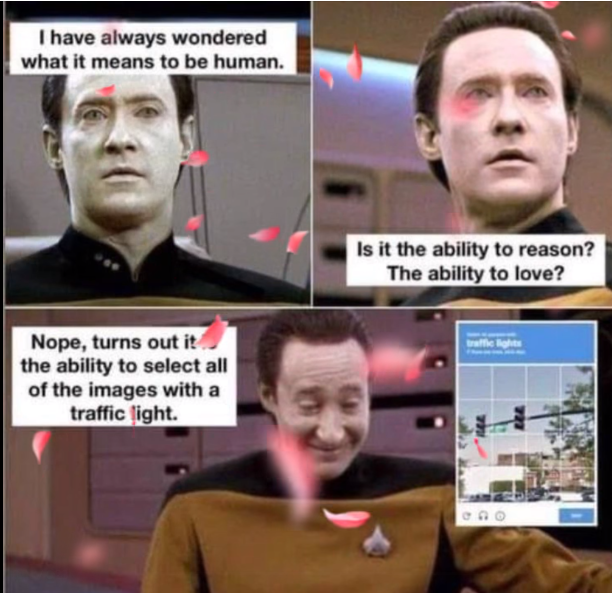
Right now, being human often feels like this…
The Path Forward: From Bluff to Agents
Case Study 1: The Marketing Team that Stopped Copy-Pasting
A mid-sized digital marketing agency used generative AI for writing ad copy, but the staff was bogged down with the grunt work of uploading hundreds of variations into Google Ads. Campaign managers spent more time copying and formatting than strategizing. When they deployed a semi-autonomous agent connected directly to the ad platform, the workflow flipped. Now, human marketers approve the creative direction, and the agent handles the uploads, testing, and reporting. Productivity skyrocketed—not because humans worked harder, but because the repetitive layer was delegated to the machine.
Case Study 2: Healthcare Without the Paper Chase
A group of clinics introduced an agent that didn’t just summarize patient visits but actually entered notes into the electronic health record, filed insurance codes, and flagged follow-ups. Doctors who once lost hours each day to clerical work suddenly had time to focus on patients again. Burnout rates dropped, while patient satisfaction climbed. The lesson was simple: when agents are trusted to act, humans regain the humanity of their professions.
Case Study 3: Small Business, Big Leverage
A boutique ecommerce seller leaned heavily on generative AI for product descriptions and social media captions, but she was still stuck uploading content, scheduling posts, and updating inventory. When she adopted an assistive agent that handled the logistics, her time freed up to design new product lines. Within months, her business doubled—not because the AI was “more creative,” but because she was finally able to focus on the creative vision herself.
Looking Ahead: Forward Scenarios for Agentic AI
- The Household of the Future
Imagine a home where AI agents aren’t just on your phone but embedded in your environment. Your grocery agent orders supplies when the fridge runs low. Your maintenance agent schedules repairs before things break. And yes, your laundry and dishes agent gets those done without complaint. Humans in that household aren’t overburdened with chores; they’re freed to paint, learn, write, or simply spend time together. - The Enterprise Reimagined
In tomorrow’s companies, agents handle 80% of the operational noise—compliance filings, scheduling, onboarding, customer service tickets. Leaders and employees spend their time imagining new products, building relationships, and setting strategy. The line between “knowledge worker” and “manager” blurs, because anyone can become a strategist when the mechanics are offloaded. - The Solo Entrepreneur, Scaled
One person with a vision could build what once required an entire team. Agents will handle finance, legal paperwork, marketing execution, and supply chain coordination. The entrepreneur sets the direction, makes high-level calls, and injects creativity. The agents do everything else. This isn’t science fiction; it’s the natural progression of where current tools are heading.
The Rallying Cry: Becoming More Human
In my book Bluff: How AI Called Humanity’s Hand, I argued that AI didn’t just disrupt industries—it revealed the bluff of work itself. For decades, we confused activity with value. AI stripped away that illusion. It showed that much of what we thought of as “knowledge work” was little more than performance theater.
The truth is this: we were never meant to be human doings, we were meant to be human beings. AI called the bluff, and agentic AI is the fix. Generative models alone left us in an upside-down world where machines “created” while humans executed. Agents flip the script—returning repetition to machines and giving humans back creativity, empathy, and vision.
This is the promise: agents don’t make us less human; they make us more human.
Your Next Step
If this resonates with you, there are two ways to take action right now:
- Read the full story. Get my book Bluff: How AI Called Humanity’s Hand and see how we got here, why the performance economy collapsed, and what it means for your future.
- Build your future. Schedule an appointment with me, and let’s explore how AI agents could transform your business. Together we can design not just chatbots, but true agents—tools that buy back your time and multiply your impact.
The future won’t belong to the ones who keep bluffing. It will belong to the ones who flip the equation, unleash the agents, and become fully human again.




 Guest Posting

