
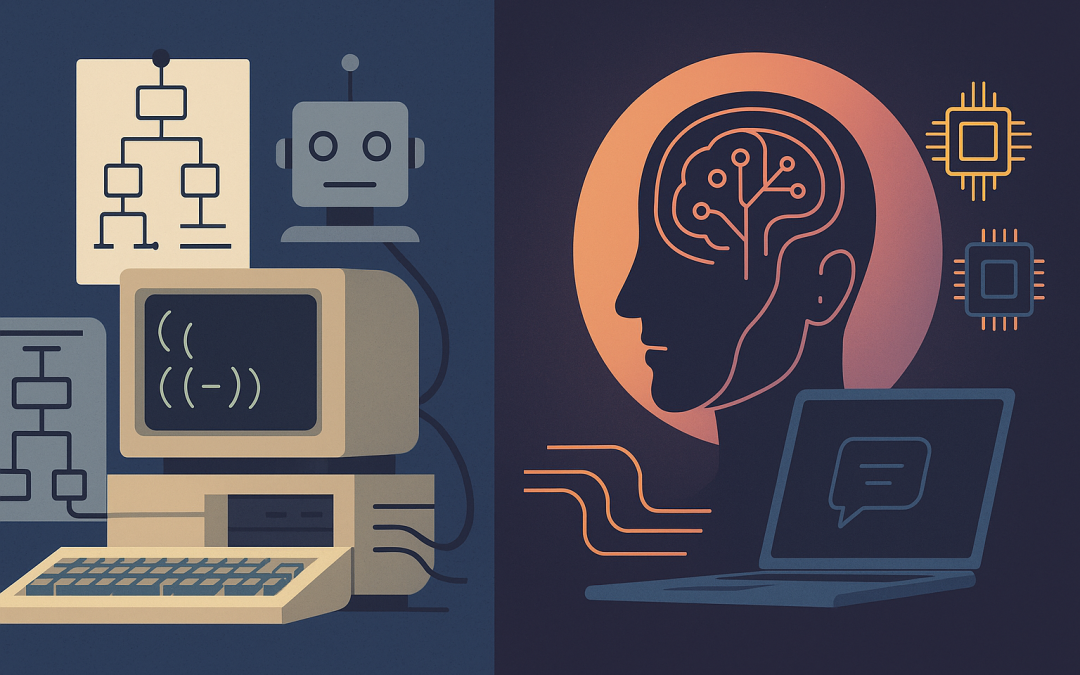
Back in the mid-1980s, I was writing code in Lisp. Not the most glamorous thing to admit at parties, but for me it was the cutting edge of what computers could do. One of my early projects was a landscape irrigation program that tied directly into AutoCAD.
Here’s how it worked. The landscape architect would draw the outline of a turf area — maybe it was an irregular kidney shape, maybe it had sharp 90-degree corners. The program would read a database of sprinkler heads that included 90-degree, 180-degree, 270-degree, 360-degree, and adjustable arc sprinklers. Based on the area’s dimensions and shape, the program would place the sprinklers in the best locations for maximum coverage.
It didn’t stop there. It would draw the connecting pipe, size the pipe to maintain optimal water pressure, and make sure every section of turf was evenly watered. This was well before “machine learning” was a buzzword. The program didn’t learn, adapt, or get smarter over time. It simply did what it was told to do — an early expert system. It followed a fixed set of rules that I had hard-coded into it. If a situation came up that I hadn’t anticipated, the program had no clue what to do.
That’s how AI worked in 1985.
The Expert System Era: Rules In, Answers Out
Back then, AI wasn’t the kind of thing you could buy off the shelf or access via a web browser. It lived in research labs, government facilities, and specialized business applications like my irrigation system.
The dominant model was the expert system. These systems mimicked the decision-making process of human experts, but only within very narrow domains. They worked by storing rules and facts in a knowledge base, then running those through an inference engine to answer questions or solve problems.
It was essentially:
If X, then Y.
If Y, then Z.
Keep chaining those rules until you get an answer.
The most famous systems of the time, like MYCIN for medical diagnosis or XCON for configuring DEC computers, were impressive for their day. But they couldn’t learn. They couldn’t adapt. They had no concept of probability or uncertainty unless you programmed it into them.
The big limitation? You had to feed them every single rule they’d ever need to know. And the moment reality deviated from your rulebook, the system would break.
That was AI in the 1980s: powerful in narrow lanes, completely clueless outside them.
The First AI Winter — and the Slow Shift to Statistical Models
By the late ’80s, the limitations of expert systems caught up with us. There was too much manual work in building and maintaining those rule sets. Businesses got tired of the cost, and funding dried up. That period became known as the first AI winter — when excitement crashed into reality, and AI research went cold for a while.
In the 1990s, a different approach started to take over: statistical and machine learning models. Instead of trying to program every possible scenario, these models learned patterns from data. Decision trees, support vector machines, and Bayesian networks started replacing pure rule-based systems.
At the time, the tools were still clunky. You’d see a mix of C++, Java, and MATLAB for the heavy lifting. Python had been invented in 1991, but it was still a niche language. Neural networks existed, but they were small and slow — more of an academic curiosity than a practical tool.
It was during this time that I shifted my focus to creating eCommerce platforms and developing online stores for my clients, mostly in the b2b space. AI simply wasn’t commercially viable.
Still, it was the beginning of the shift from “tell the computer exactly what to do” to “show the computer examples and let it figure it out.”
The Breakthrough of 2012: Deep Learning Changes Everything
The real turning point for modern AI came in 2012 with a competition called ImageNet. Researchers Geoffrey Hinton, Alex Krizhevsky, and Ilya Sutskever built a deep neural network called AlexNet that blew away every other system at the time. It wasn’t just a little better — it cut the error rate almost in half.
Why was this such a big deal?
It proved that neural networks could scale when you combined massive datasets with something new: GPU acceleration.
Instead of relying on CPUs to process data one step at a time, AlexNet used NVIDIA GPUs to do parallel processing, crunching thousands of operations simultaneously.
What once would have taken weeks to train could now be done in days.
That was the spark. Suddenly, neural nets weren’t academic curiosities anymore. They were practical, and they outperformed the old statistical methods.
AlexNet’s win kicked off the deep learning boom. From computer vision, it quickly spread into speech recognition, translation, and eventually natural language. You can draw a straight line from that moment — and those NVIDIA GPUs — to everything we’re seeing today.
What I Was Building at the Time
While researchers were proving that deep learning could change everything, I was on a different track. Around 2015, my focus was eCommerce. I started experimenting with flowchart-style chatbots like ManyChat and ChatFuel. They weren’t powered by deep learning yet — they were still decision-tree systems at their core — but for business owners, they looked futuristic.
A ManyChat flow would look like a mind map:
If the customer says “shipping,” send them the shipping info.
If they say “return,” send them the return policy.
If they say something unexpected, reply with “Sorry, I didn’t understand. Can you rephrase?”
These bots were fast, automated, and effective for their purpose. But they were still closer to my 1980s irrigation program than to the breakthroughs happening in research labs. They worked inside their pre-defined rules, and that was it.
For me, that era was a reminder that commercial AI and research AI don’t always move in sync. Businesses had chatbots long before they had GPTs — but the underlying intelligence was still shallow.
Transformers and the GPT Era
The next big leap came in 2017, when Google researchers introduced the Transformer architecture in a paper called Attention Is All You Need. Instead of processing words one at a time like RNNs, Transformers could look at all the words in a sequence at once and figure out how they relate to each other. That made them faster, more powerful, and far more scalable.
By 2018, OpenAI launched the first GPT (Generative Pre-trained Transformer), proving that Transformers weren’t just for translation — they could generate text that sounded human. GPT-2 followed in 2019, and GPT-3 in 2020. But all of those were still research versions. However, On November 30, 2022, OpenAI released ChatGPT 3.5 to the public. Within 5 days, over 1 million users had registered with OpenAI (of course I was one of them). Overnight, the world changed. The leap to GPT-4 and GPT-5 brought multimodal capabilities: handling text, images, audio, and even video.
But, without that 2012 ImageNet breakthrough, it’s unlikely anyone would’ve invested the energy to build Transformers or scale them into the GPTs we use today.
The Third Wave: LLMs and APIs
Today, things are different. I’m still building specialized tools for businesses, but now I’m calling APIs from OpenAI, Claude, Mistral, Llama, DeepSeek, and others. Instead of hand-coding every possible answer, I can build a system that actually learns and adapts from the data it’s fed.
If you give a modern large language model (LLM) enough examples of your tone, product catalog, and customer history, it can:
Understand a customer’s free-form question.
Search your database for the right answer.
Write the answer in a way that matches your brand voice.
Improve over time as it gets feedback.
I’m no longer limited to a rigid flowchart. Instead, I’m building AI agents that can handle complex tasks from start to finish — things that once would’ve required multiple separate programs.
AI Evolution Timeline — From Lisp to LLMs
Here’s how I’ve seen AI evolve over the last 40 years (yes, it started back in the 1050’s, but that was before my involvement):
1985–1990: Expert System Era
Languages: Lisp, Prolog, some C.
AI built around rule-based logic.
My irrigation program fits here — all rules, no learning.
Limitation: Can’t adapt to anything outside the rule set.
1990–2005: Rise of Statistical Models
Shift from rules to data-driven decisions.
Algorithms: decision trees, Bayesian networks, SVMs.
Languages: C++, Java, MATLAB for research.
Python emerges but is not yet dominant.
First signs of neural networks.
2005–2012: Foundations for Modern AI
Big data and GPUs start making larger models possible.
Python starts gaining traction with NumPy and scikit-learn.
ImageNet competition begins.
Deep learning still niche.
2012–2016: Deep Learning Revolution
AlexNet wins ImageNet in 2012, proving deep neural networks can outperform older models.
Python becomes the primary AI language thanks to TensorFlow and PyTorch.
Expert systems fade into history.
2017–2019: Transformer Models
Google releases Transformer architecture in 2017.
Hugging Face makes NLP easier to implement.
Chatbots like ManyChat still use flows but can integrate with NLP for intent detection.
2019–2022: LLM Growth
GPT-2 and GPT-3 show what massive transformers can do.
Cloud APIs make AI more accessible.
Chatbots begin integrating LLMs for better conversation.
2023–2025: Multimodal Agents
GPT-4, Claude, Gemini, Mistral handle text, images, audio, and video.
AI agents perform multi-step tasks autonomously.
Python still king for development, but no-code AI tools let non-programmers build their own agents.
What’s Changed Since 1985
1. Computing Power
1985: Megabytes of RAM. Today: terabytes in the cloud.
GPUs and TPUs make deep learning possible.
2. Data Availability
1985: Manually collected, small datasets.
Today: massive internet-scale datasets.
3. Algorithms
1985: Rule-based expert systems.
Today: neural networks, transformers, reinforcement learning.
4. Accessibility
1985: Locked in labs and R&D.
Today: Available to anyone with a browser.
5. Cost
1985: Millions for an AI project.
Today: A few cents per API call.
What’s Still the Same
1. The Goal
Mimic or augment human intelligence.
2. Core Ingredients
Data, algorithms, compute power — just at different scales.
3. Hype Cycles
Overpromising, disappointment, then breakthroughs.
4. Human Guidance
Still need people to frame problems and evaluate results.
5. Ethical Questions
Job loss, bias, control — same debates, bigger stakes.
The Bridge from Then to Now
Looking back, my Lisp irrigation program and my early ManyChat bots are distant relatives of what I’m building today. The DNA is the same — structured logic and domain-specific expertise — but the capabilities are radically different.
The old systems were like chess masters who had memorized every possible game up to a certain point but couldn’t improvise beyond that. Modern AI is more like a grandmaster who can walk into any game, study the board for a moment, and adapt on the fly — even if the rules change mid-match.
And that adaptability is why AI today feels less like a tool you use and more like a partner you work with.
Why This Matters for You
Here’s the key takeaway: the same breakthroughs that took AI from hard-coded rules to adaptive partners are the same shifts that can unlock new opportunities in your business. If you’re still thinking of AI as a gimmick or as “just another tool,” you’re missing the point. It’s becoming the operating system of growth.
That’s what I dive deeper into in my book, Bluff: How AI Called Humanity’s Hand. It’s part history, part warning, and part playbook for how leaders can navigate this shift.
But books are just the beginning. If you’re ready to explore how AI can actually work inside your company — whether that’s building a digital twin of yourself, automating processes, or creating new revenue streams — that’s the work I do every day as the AI Architect for Business Growth.
Next Steps
Grab a copy of Bluff if you want the bigger picture of what’s really happening. https://amzn.to/4mPBkIl
Or, if you’d rather skip the theory and start applying AI in your business, book a call with me and let’s build a strategy together. https://calend.ly/gregjameson
Because the truth is simple: AI isn’t coming someday. It’s here. As Sam Altman (CEO of OpenAI) said, “We are already out of the first inning. The best thing you can do is to start figuring out how to use it to start doing things and not just asking it simple questions.”







 Guest Posting

