
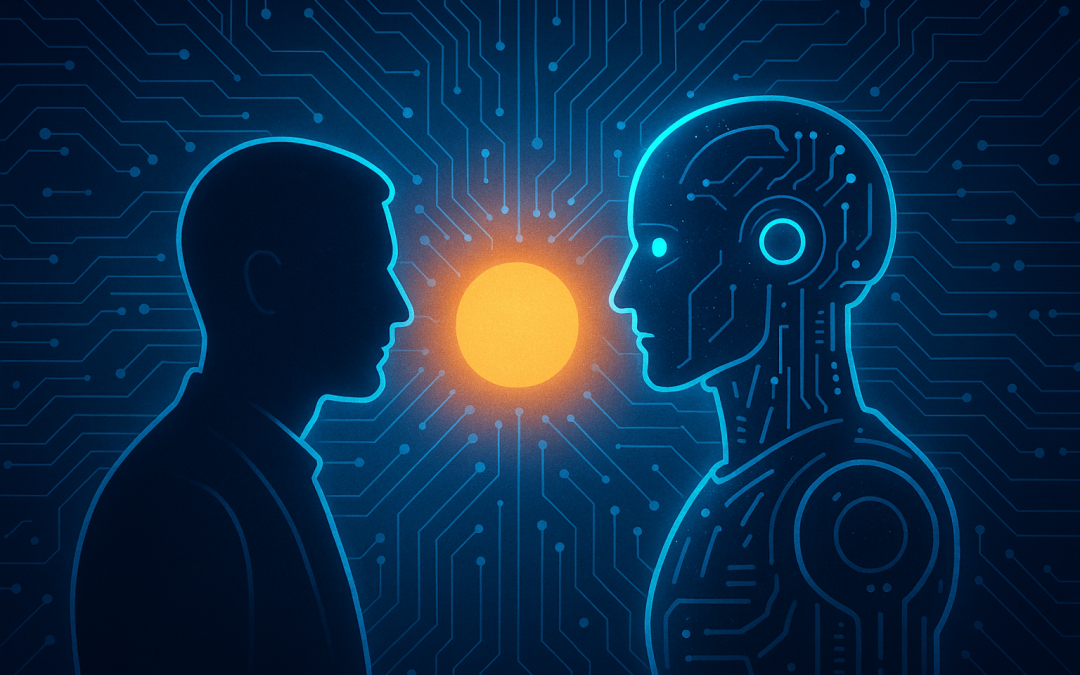
Last week I shared my personal journey with AI, going all the way back to the days of teletype machines and the early sparks that shaped my entire career. That was the past. This week, I want to look forward. I want to talk about where AI is actually heading, what’s real, what’s noise, and what I believe we’re walking toward as this bubble keeps growing.
Every day I talk with entrepreneurs, coaches, and business owners who are trying to make sense of all the hype. Layoffs, headlines, AGI predictions, doomsday warnings, trillion-dollar valuations, and endless conversations about whether AI is about to take everything from us.
The truth is a whole lot more grounded, and a whole lot more human, than the fear-driven narratives suggest.
Let’s pick up from where we left off last week and look at what the future actually holds.
Yes, we’re living through an AI bubble
You don’t get this kind of spending, confusion, and frenzy without calling it what it is. Companies are pouring money into AI projects they can’t explain and don’t know how to measure. It’s a classic bubble pattern.
But here’s the part nobody is talking about loudly enough:
Most of the money being poured into AI right now isn’t producing real economic returns. Studies have shown that the majority of corporate AI pilots deliver no measurable ROI at all. Companies are spending because they feel like they’re supposed to be spending.
It’s the “we can’t be left behind” mentality that we’ve seen in every major hype cycle.
And here’s a real-world signal worth noting. Peter Thiel’s fund quietly sold its entire stake in Nvidia in Q3 of this year. You don’t dump a position in the most iconic AI hardware company on the planet unless you see risk ahead. When an insider with that track record steps out, it’s usually a sign they believe the bubble might be closer to the top than most people think.
Note: I am of course talking about an economic bubble, not a technical one. The technology shows no signs of slowing down.
Is this bubble dangerous to the economy?
Surprisingly, not in the way people think.
AI investment today isn’t like subprime mortgages in 2008 or junk bonds in the 80s. It’s not heavily leveraged. The money being spent is mostly big tech capital, VC funding, or internal budgets. If the bubble pops, the pain lands in:
tech stocks
venture capital portfolios
overextended startups
It doesn’t instantly translate into a global economic collapse. It’s more like the dot-com crash. Ugly for some, but survivable for most.
That doesn’t mean there won’t be fallout.
It just means AI isn’t the doomsday switch.
And that takes us directly into the layoff problem.
So what’s behind all these layoffs being blamed on AI?
Let’s be honest. AI is being used as a convenient cover story.
Most layoffs are not caused by AI replacing jobs. They’re caused by:
over-hiring
slowing revenue
high interest rates
pressure from investors
When a CEO says “AI transformation,” it sounds smart. It sounds bold. It doesn’t sound like “we made expensive mistakes and need to fix them.”
And here’s the giveaway: many of these same companies are firing people one week and hiring “AI-skilled workers” the next. That’s not automation. That’s optics.
Why not train their loyal employees?
Because layoffs give instant results. Training takes patience. And patience isn’t part of quarterly earnings calls.
And here’s the part that drives me nuts.
If all you’re using AI for is layoffs and squeezing out efficiency, you’re missing the most important aspect of the most powerful tool ever created.
AI isn’t here just to cut costs. AI is here to multiply what humans can do. It’s the first tool in history that gives you the ability to scale yourself.
If the only thing a company takes from this moment is “how can we replace people,” they’ve already lost the bigger opportunity.
Are jobs actually changing? Yes. But this is evolution, not extinction.
AI is already taking over the repetitive, predictable, text-heavy work. That part is real. Entry-level white-collar jobs will feel the squeeze first.
But this is not new. It’s the same pattern we’ve seen with every major technological shift.
Low-value tasks disappear.
High-value work expands.
The middle gets restructured.
The people who learn how to use AI, not fear it, will get ahead faster than at any time in the past twenty years. I see it happen every day through the tools I build and the entrepreneurs I work with.
What’s actually behind the curtain
Let’s clear up one of the biggest misconceptions right now.
AI is not conscious.
Not even remotely close.
Behind the curtain, these impressive models are:
pattern recognizers
math engines
probability machines
trained on mountains of data
running on oceans of hardware
They don’t “think.”
They don’t “feel.”
They don’t “want.”
They don’t have inner lives.
They generate what looks like understanding because they can predict patterns incredibly well. But predicting language is not the same as having consciousness.
The real danger isn’t the system becoming too smart.
The real danger is people assuming the system understands everything when it’s really just reflecting patterns back at us.
And here’s another angle worth keeping in mind: the industry might be building more infrastructure than real business value. You’ve got massive GPU clusters, data centers expanding like crazy, and investors acting like capacity itself is the product. Thiel’s concern overlaps right here. When compute gets built faster than clear economic use cases, that’s when bubbles start getting fragile.
A Look Ahead: What’s Actually Coming Next
Since this article is about the future, let’s talk about what’s realistically on the horizon. Not sci-fi fantasies, but genuine technological advances we’re likely to see in the next few years and how they tie into everything else I’m saying.
ChatGPT-6 and ChatGPT-7
We’re going to see:
better reasoning
stronger memory
improved planning
fewer hallucinations
richer multimodal interaction
But even with those upgrades, these systems won’t suddenly “wake up.” They’ll still be tools. More powerful tools, but tools nonetheless.
More Autonomy
Next-gen agents will take on multi-step tasks without constant human supervision: managing inboxes, organizing data, running research loops. It’ll feel like magic the first time you see it happen, but underneath, it’s still automation with rules.
Robotics
We’ll see humanoid robots moving into real workplaces. Not creepy sci-fi robots, but practical ones that can carry, assemble, navigate, and handle tasks that are hard or dangerous for humans.
But again, no intentions. No desires. Just more flexible versions of machinery we already trust.
AGI
Are we moving toward AGI? Probably—though nobody agrees on what that even means yet. But AGI won’t land with a thunderclap and replace humanity overnight. It’ll arrive in layers. Slowly, unevenly, with tons of human delays from policy, fear, and misunderstanding.
Whatever AGI becomes, it’s far more likely to extend human capability than erase it.
A Reality Check: Security, Stability, and the Risks We Should Actually Be Paying Attention To
Before we dive deeper into AGI, let’s talk about something more immediate. Everyone loves discussing the future, but the real risks today don’t come from superintelligence. They come from us being careless with the tools we already have.
A recent analysis of OpenAI’s new Atlas browser pointed out that as we give AI more access—to our data, our systems, our workflows—we also expand the attack surface. Researchers found ways to trick an AI-powered browser using malicious sites, hidden commands, or spoofed sidebars. It’s the cybersecurity playbook rewritten in AI’s handwriting.
This doesn’t mean AI is unsafe. It means we shouldn’t hand it the keys to our business without checking whether the garage door even locks.
Then there’s the article making the rounds claiming that “GPT-6 is unstable and dangerous.” Since GPT-6 isn’t even publicly released, take the theatrics lightly, but the underlying point matters. As models get bigger, they don’t automatically get safer. They get more complex. More sensitive. More capable of misfiring if we don’t define guardrails and keep humans in charge.
And now we can layer in the Thiel perspective: a lot of the risk isn’t dystopian science fiction, it’s simple economics. When investors start backing away, when the cost of compute skyrockets, when infrastructure outpaces returns, companies panic. They pull back. They cut corners. They overreact. None of this has anything to do with AI becoming “too powerful.” It’s all human overcorrection.
You don’t need a conscious machine to cause problems—just a powerful one with the wrong instructions and too much freedom.
So when you hear about vulnerabilities or instability, don’t let it feed the dystopian narrative. Just treat it as a reminder that as AI becomes more capable, our responsibility has to scale with it.
The risk isn’t that AI becomes too smart.
The risk is that we get sloppy.
Are we heading toward AGI? Probably. But not the Hollywood version.
We’re making progress. It’s exciting to watch. But we’re still far from a system that can reason, reflect, plan long-term, or act with true autonomy.
Even if AGI arrives, it won’t be a sudden explosion that catches the world off guard. Technology never works like that. Humans slow everything down—through doubt, politics, regulation, incentives, budgets, and plain old confusion.
What’s coming will be powerful, but it won’t be a machine uprising. It will be a set of tools that expand what humans can do, not erase why we’re here.
The real risks are human, not robotic
If there’s a dystopia coming, it won’t be because AI “takes over.” It will be because humans:
make reckless decisions
use AI for control instead of empowerment
concentrate wealth and power even more
regulate based on fear instead of understanding
choose layoffs over training
chase hype instead of building value
AI doesn’t create dystopias.
People do.
But the good news is we can just as easily create a future where we multiply ourselves, serve more people, and actually become more human as the machines take over the busywork.
That future is already happening for people who embrace these tools instead of avoiding them.
The bubble will burst… and that’s when things get interesting
Like every bubble, this one will eventually pop. The hype will fade. The nonsense will burn off. And what remains will be the companies and creators who actually build value.
And this is where the Thiel angle fits perfectly. If major investors are already stepping out, that means the correction is coming sooner rather than later. And when it hits, the businesses that stayed focused on real impact—not hype—are going to have the advantage.
Last week I told the story of how I got here. This week I’m telling you where I believe we’re going.
We’re headed into a world where:
the people who learn AI will thrive
the businesses that retrain their teams will win
the entrepreneurs who multiply themselves will leapfrog their competition
and the fear-driven predictions will look pretty silly in hindsight
And let me say this clearly, because it needs to be said.
People like me aren’t pushing AI because we want to wipe out jobs. I’m not trying to destroy anyone’s career, including my own. I’ve spent my entire life helping people build businesses, create opportunity, and open doors that didn’t exist before.
I don’t believe humans are meant to do less.
I believe we’re meant to do more.
More creating.
More serving.
More connecting.
More living.
AI isn’t here to take that away.
It’s here to take away the busywork that keeps us from it.
We’re not being replaced.
We’re being amplified.
And if we play this right, the next decade could be the most exciting one yet. And that is something to be thankful for.
Happy Thanksgiving!





 Guest Posting

