
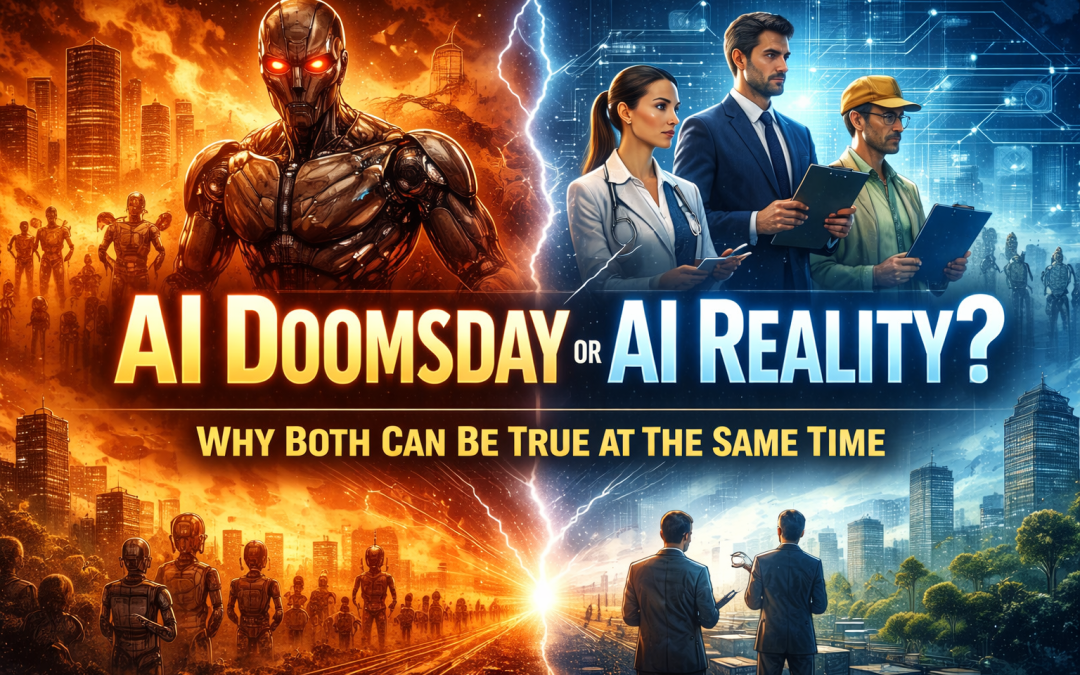
There is a growing split in the conversation about artificial intelligence.
On one side, you hear warnings that AI could wipe out large portions of the workforce within a few years, a total AI Doomsday. Some respected researchers and technologists are openly concerned about the scale and speed of disruption. Geoffrey Hinton, often called one of the pioneers of modern AI, has spoken about the potential for massive societal change and the possibility that we are underestimating the impact.
On the other side, many business owners are quietly wondering if this is all being exaggerated. They look around and see plumbers still fixing pipes, restaurants still serving meals, and professionals still doing the work they have always done.
So who is right?
The honest answer is that both perspectives contain truth.
The fear is not irrational
In my book Bluff, I talk about the idea that humanity has been living under certain assumptions about work, intelligence, and value. Artificial intelligence is beginning to challenge those assumptions.
We are already seeing AI automate tasks that once required years of training. Customer service responses, basic legal research, content production, software testing, and data analysis are being accelerated at a pace that feels unprecedented. Entire workflows are being redesigned around machines that can learn patterns faster than humans.
When people like Hinton sound alarms, they are reacting to real capability curves. AI is improving quickly, and economic incentives will drive businesses to use tools that increase efficiency and reduce costs.
It would be naïve to assume this has no consequences.
But the AI doomsday narrative often ignores how change actually happens
Predictions that most jobs will disappear by a specific year assume that technology adoption is instantaneous and uniform. History suggests otherwise.
Industrial automation did not eliminate factory jobs overnight.
The internet did not eliminate physical retail overnight.
Mobile technology did not eliminate traditional services overnight.
Instead, jobs evolved. Some roles disappeared. Many new ones emerged. Entire industries transformed over time rather than in a single dramatic moment.
The same pattern is likely with AI.
As discussed in my recent article about whether we really need to “learn AI,” many professions will continue to exist while the environment around them changes. Tradespeople will still perform physical work. Service providers will still rely on human relationships. Local businesses will still compete on experience and trust.
What will shift is the business layer, how customers discover services, how operations are managed, and how expertise is delivered.
The real disruption is happening at the level of tasks, not entire occupations
AI is exceptionally good at automating components of work. It can draft documents, summarize research, generate marketing copy, assist with diagnostics, and help write software. This means fewer people may be needed for certain functions, especially routine digital tasks.
But most jobs are not a single task. They are a combination of judgment, accountability, creativity, and interaction.
A doctor may rely on AI for documentation and pattern recognition but still provide human care.
A lawyer may use intelligent research tools while maintaining responsibility for strategy and client relationships.
A software engineer may collaborate with AI assistants yet remain essential for architecture and decision-making.
Jobs are being reshaped rather than erased.
AI is becoming infrastructure, not just a tool
One of the themes I explore in Bluff is that transformative technologies eventually fade into the background. Electricity, computing, and the internet all followed this path. They disrupted existing systems, created new opportunities, and then became part of daily life.
Artificial intelligence is likely to do the same.
We will reach a point where people stop talking about “using AI” and simply use products and services that contain it. The real competitive advantage will belong to those who adapt their business models, not necessarily those who master the underlying technology.
Preparation matters, panic does not
Acknowledging risk does not mean surrendering to fear. It means preparing thoughtfully.
Businesses should be asking:
• Where can AI improve efficiency or customer experience?
• Which roles may change and how can people be retrained or repositioned?
• How will expectations shift as competitors adopt new capabilities?
At the same time, it is important to recognize that society has navigated disruptive change before. Economic systems evolve. New forms of work emerge. Human needs continue to create opportunities.
The challenge is not to predict the exact outcome.
The challenge is to stay aware and adaptable.
The future will not be a simple story
Artificial intelligence will change humanity in meaningful ways. It will reshape how knowledge is created, how services are delivered, and how businesses scale. Some industries will experience rapid disruption. Others will change gradually.
Doomsday predictions capture the magnitude of potential transformation.
Everyday reality reflects the slower, more complex process of adaptation.
Both can be true at the same time.
The most productive response is neither denial nor panic. It is deliberate preparation.
We do not need to assume that all jobs will vanish overnight.
We do need to recognize that the nature of work is evolving.
Those who stay curious, focus on practical leverage, and adapt their strategies will be better positioned for whatever comes next.







 Guest Posting

