
A friend of mine, Joel Comm, recently wrote about something that perfectly illustrates the AI divide I’ve been talking about.
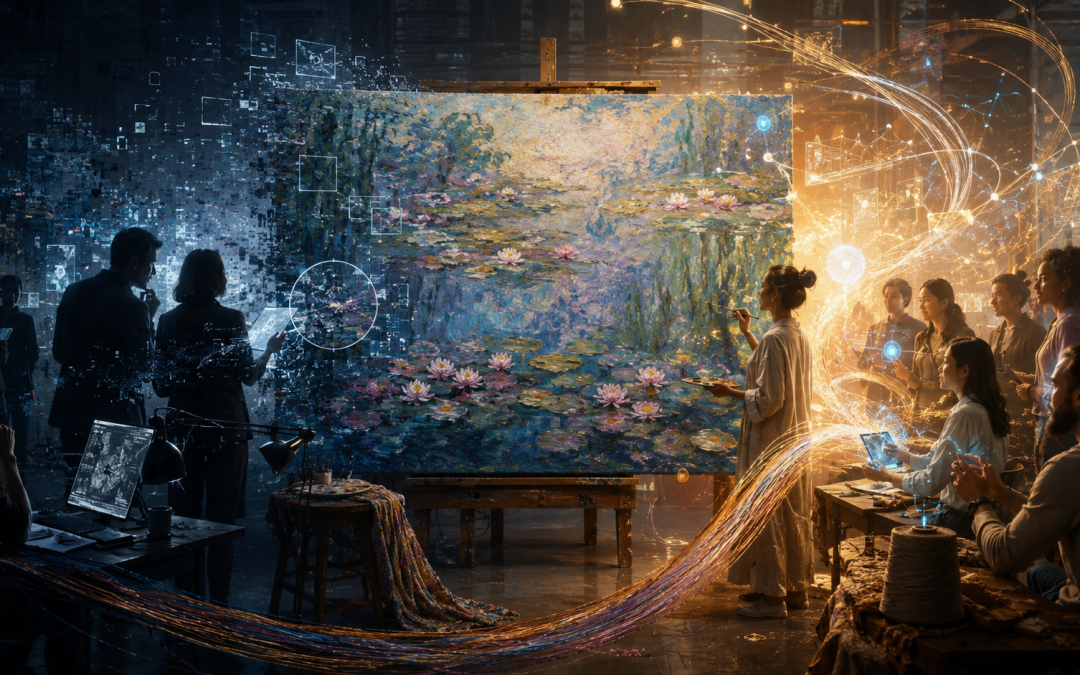
An artist and provocateur named SHL0MS posted an image on X and told people it was AI-generated in the style of Monet. The request was simple: explain, in as much detail as possible, what made it inferior to a real Monet. People jumped in with confidence. They criticized the composition, the emotion, the technique, the blending — just about everything they could find wrong with it. Some called it garbage.
There was only one problem. It was a real Monet.
According to PetaPixel, SHL0MS had posted an actual Monet painting and asked people to explain why it fell short of the genuine article. The painting didn’t change. The brushstrokes didn’t change. The only thing that changed was what people were told about where it came from. And that was enough to turn a celebrated work by one of the most recognizable painters in history into something people were suddenly eager to dismiss.
That is what makes it so powerful — and so uncomfortable.
Research backs this up. A study published in Scientific Reports found that people devalue art labeled as AI-made across several dimensions, even when they say it’s indistinguishable from human-made work. They’re not always reacting to what they can see. They’re reacting to what they believe the thing is. The label is doing the judging.
This reminds me of the Navajo concept of the spirit line — ch’ihónít’i — a deliberate pathway woven into a rug that allows the weaver’s spirit to exit. What looks like an imperfection carries meaning, intention, and spiritual significance. For centuries, human beings have understood that imperfection is not always a defect. Sometimes it’s evidence of the maker.
The AI debate has twisted that instinct into something strange. When people thought they were looking at AI, they went hunting for imperfection as proof of failure. Once they knew it was Monet, those same imperfections had to be reinterpreted as artistic expression. The flaw didn’t change. The story around it did.
This is not a one-off internet prank. We saw it in Bozeman, Montana, where a Christmas art contest winner was accused of being AI-generated. The artist denied it, said the piece was hand-rendered and digitally refined, but the suspicion alone triggered public backlash. The organizers eventually chose not to distribute the poster. Whether or not AI was actually involved became almost secondary to the accusation that it might be.
We’ve also seen the reverse — AI-assisted work winning recognition and people arguing over whether it deserved to be in the same category as human-made work, as happened with the image that won the Colorado State Fair digital art competition in 2022.
The real problem isn’t AI. It’s that we’ve stopped judging the work and started judging the category.
And before the pro-AI crowd gets smug, this cuts both ways. Some people are so excited about AI that they automatically assume anything AI-generated is impressive simply because it’s AI. They overlook errors, hallucinations, fake citations, lazy writing, and shallow thinking because they’re dazzled by the tool. That’s not discernment either.
One side sees “AI” and assumes failure. The other sees “AI” and assumes the future. Both reactions can keep us from seeing clearly.
The right position isn’t anti-AI or pro-AI. It’s pro-human. That means caring about human creativity, human dignity, human judgment, and human meaning — while being honest about when AI is genuinely amplifying human potential and when it’s just replacing human care with cheap automation. If an AI-assisted tool helps someone learn, create, heal, or build something better, acknowledge the value. If AI-generated content is shallow, misleading, or harmful, call it out. But in both cases, the judgment should come from the work — not the label attached to it.
The Monet experiment exposes something else, too. When the truth was revealed, some people got the point immediately. Others doubled down and found new reasons to keep criticizing the painting. They attacked the reproduction quality. They said it wasn’t his best work. They said the experiment was unfair. Anything to avoid saying, “I let the label do my thinking for me.”
That may be the most human part of the whole story.
We’ve all done some version of this — not necessarily with a Monet, not necessarily with AI, but we’ve all reacted to a label before fully examining the thing itself. Political party. News source. Brand name. Social media tribe. The label arrives first, and our judgment follows behind, pretending it was independent all along.
AI is just the latest and loudest version of that problem.
If someone can show us a Monet, tell us it was made by a machine, and we suddenly see garbage — the problem isn’t artificial intelligence.
The problem is that our own intelligence has become easier to manipulate than we want to admit.







 Guest Posting

