
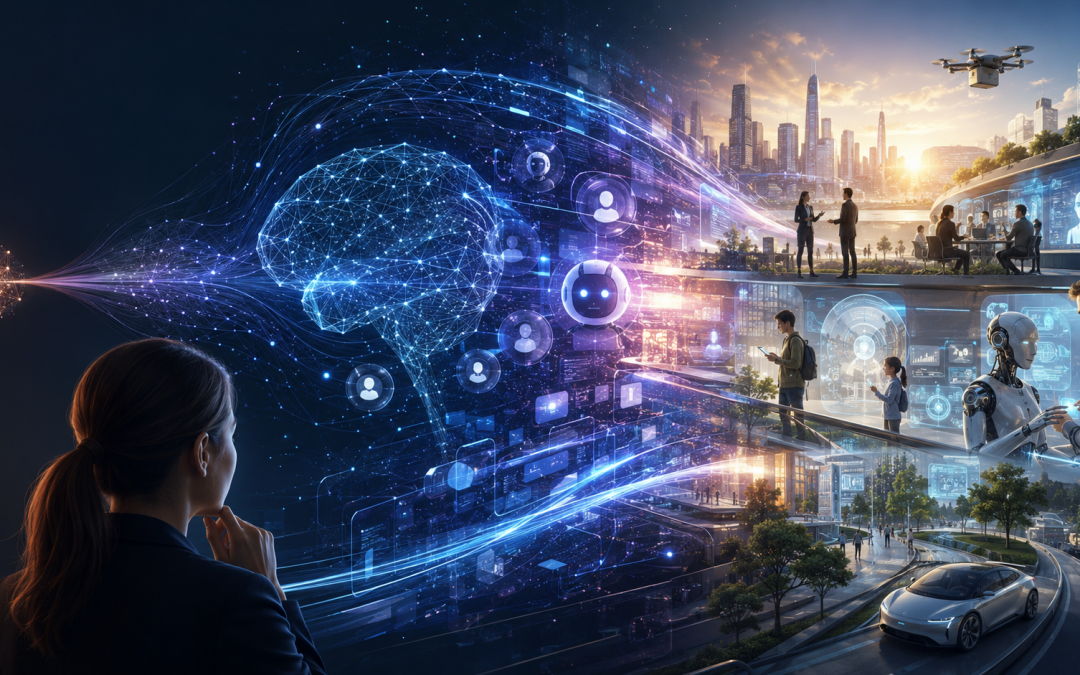
| TL;DR: Nobody knows exactly when AGI arrives, and predicting a date is mostly a way of sounding confident while guessing. What we can say is that AI capability has been compounding at a pace most people haven’t fully registered yet, and by 2031 that compounding lands somewhere consequential. AI stops being a tool you visit and becomes a layer baked into how your business runs. Agents handle multi-step workflows, not just single tasks. Your website starts functioning like a conversation. Every expert with something worth knowing needs a digital version of that knowledge running around the clock. Education gets personal in ways a classroom never could. And small teams start doing things that previously required much bigger ones. The human side is harder to forecast but probably more important. Some jobs shrink. More significantly, a lot of people’s sense of their own worth is going to need some rethinking, because AI puts pressure on usefulness as an identity. The answer isn’t that humans become irrelevant. It’s that value moves up the stack, toward judgment, creativity, trust, and the ability to define the right problem in the first place. The person who owns the outcome becomes more valuable when the machine handles more of the doing. The bottom line is this: you don’t need to wait for AGI to feel this. The ground is already moving. The businesses that understand that early have one of the wider open windows I’ve seen in a long career of watching new technologies announce themselves. |
Every few years someone declares that the future has arrived, and most of the time they turn out to be early, wrong, or selling something. So when I hear confident predictions that artificial general intelligence will land by 2030, my first instinct is to ask what the person making the claim has to gain from it. Maybe AGI shows up on schedule. Maybe it doesn’t. Nobody actually knows, and anyone who tells you they do is guessing with a straight face.
That uncertainty doesn’t leave us flying blind, though. We can’t name the day AGI arrives, but we can look at the curve we are already riding. We know what happened in 2017, we know what changed when ChatGPT went public at the end of 2022, and we know roughly where things stand now in the middle of 2026. From there we can ask a more useful question than when does AGI get here. The better question is what AI will reliably be able to do five years from now that it can’t do today, because that is where both the opportunity and the disruption live.
I have been around long enough to have watched a few of these waves break. I started programming on a DEC PDP-10 mainframe that I reached through a teletype machine, back when an hour of computer time a week felt like a luxury. I built a CAD software company through the desktop revolution, watched the internet arrive and quietly rewrite every business model I thought I understood, and I have been working with AI tools daily for the last few years. None of that makes me a prophet. But it does mean I have seen the pattern where a new technology looks like a toy right up until the morning it looks inevitable, and I would rather understand that pattern than bet on a date.
2017: The Spark
The modern wave really started in 2017 with a research paper that almost nobody outside the field noticed at the time. It was called Attention Is All You Need, and it introduced something called the Transformer, an architecture that gave machines a far better way to handle language, context, and the relationships between words at enormous scale. AI had already moved through earlier phases by then, the expert systems and neural networks and machine learning and the recommendation engines that decide what you watch next. The Transformer was different because it opened the door to large language models, the technology sitting underneath every chatbot you have used since. There was no stampede when that paper came out, no cable news panic, no business owners suddenly asking whether they needed an AI strategy. It was just a paper. Looking back, it was the spark.
2022: The Public Starting Gun
ChatGPT opened to the public on November 30, 2022, and that date matters less for what the technology could do than for who suddenly noticed it. People who had never written a line of code or thought twice about neural networks were sitting at their kitchen tables asking a machine to draft emails, explain their taxes, help with homework, and write business plans. What surprised them was not only that it answered. It was that it felt like a conversation, something that followed along, revised, and explained itself. It hallucinated, it misunderstood things, it got plenty wrong, and it still changed the conversation overnight, because for the first time AI was something ordinary people could feel. If 2017 was the spark, late 2022 was the starting gun.
2026: The Tool Becomes a System
That brings us to now. The AI of 2022 was essentially a clever conversational assistant. The AI of the middle of 2026 is becoming something closer to a work partner, and the difference is not cosmetic. Today’s systems write and code and translate, they read screenshots and listen to audio, they search the web, they generate images and video, and they string together multi-step tasks the older models could not have attempted. They still need supervision, they still need guardrails, and they still make mistakes that would embarrass a careful intern. But a conversational assistant hands you an answer, while a work partner helps you produce an outcome, and that is the direction everything is moving.
The Exponential Curve
Here is one way to picture the pace. Researchers at METR have been tracking something they call an AI agent’s task horizon, which is the length of a job, measured by how long it would take a skilled human, that an AI can finish on its own with at least a fifty percent success rate. Across roughly the last six years, that horizon has been doubling about every seven months. I want to be careful about what that does and does not mean, because this is exactly the kind of number that gets quoted loosely and then sprints away from the evidence. It is specifically a measure of software and coding tasks, not a general intelligence meter, and the data really starts around 2019 with systems that could barely handle a task that took a human a few seconds. It is a useful proxy for capability, not a law of physics.
If you take that seven-month doubling and turn it into an annual figure, you get growth of roughly 3.28 times per year. Start an index at 1 in 2017, the year of the Transformer paper, let it compound, and you get a table that looks like this:
| Year | Compounding Index (2017 = 1) | Increase vs. 2017 |
| 2017 | 1 | 1x |
| 2018 | 3 | 3x |
| 2019 | 11 | 11x |
| 2020 | 35 | 35x |
| 2021 | 116 | 116x |
| 2022 | 380 | 380x |
| 2023 | 1,248 | 1,248x |
| 2024 | 4,096 | 4,096x |
| 2025 | 13,440 | 13,440x |
| 2026 | 44,103 | 44,103x |
| 2027 | 144,715 | 144,715x |
| 2028 | 474,860 | 474,860x |
| 2029 | 1,558,178 | 1,558,178x |
| 2030 | 5,112,914 | 5,112,914x |
| 2031 | 16,773,238 | 16,773,238x |
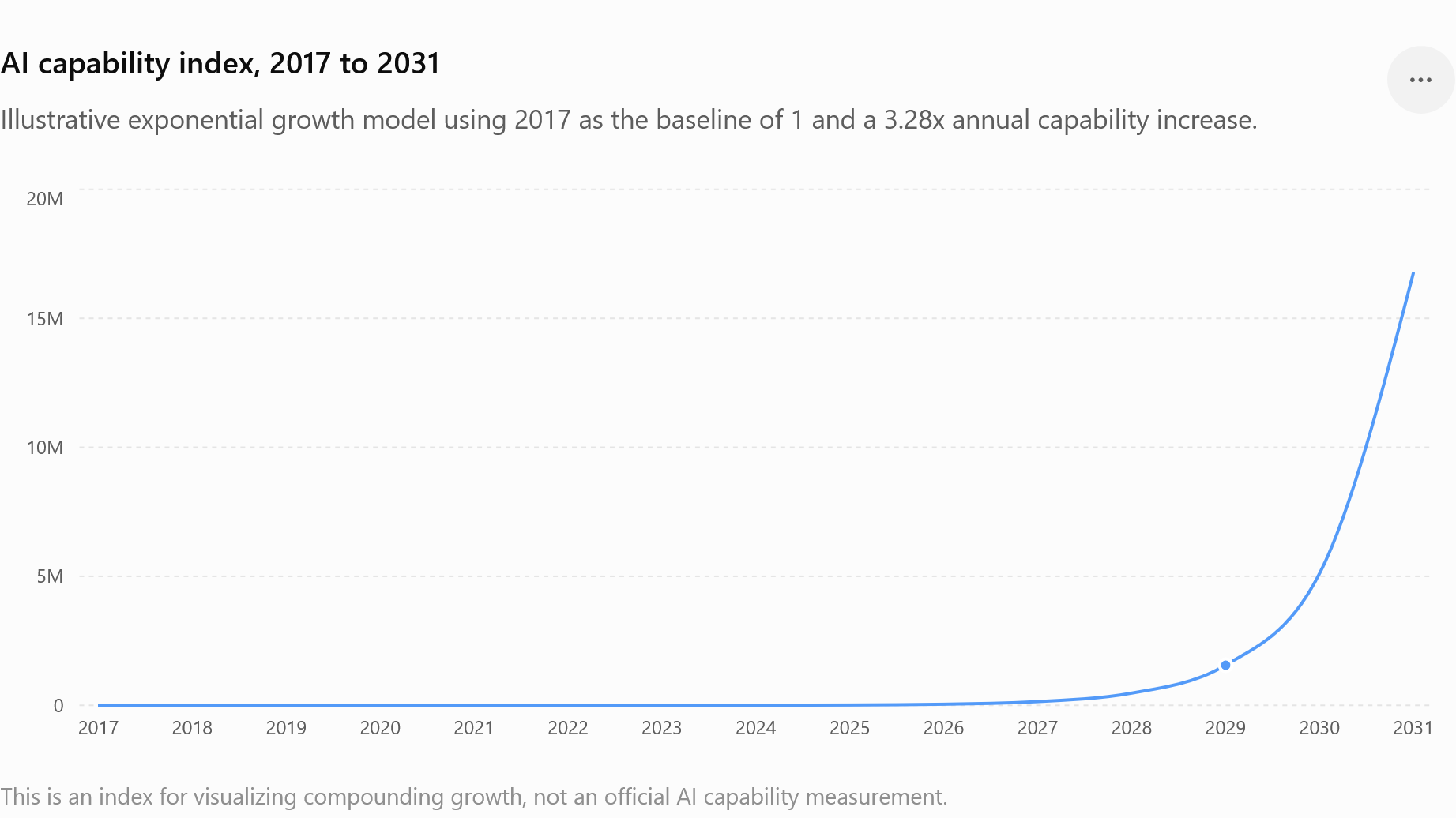
Now please do not read that last row as a literal claim that AI will be sixteen million times smarter in 2031. There is no official capability meter that spits out these numbers. The index is only a way to make compounding visible, and METR itself warns that the far end of this curve becomes unreliable as the tasks start saturating the available tests. There is even a wrinkle that cuts against my own neat table, which is that more recent measurements suggest the doubling time may have sped up to something closer to four months over the last couple of years. That would make these figures conservative rather than aggressive, and I am not betting the house on either reading. The point survives even if the curve is wrong by a factor of ten in either direction. We are not looking at the steady, incremental improvement humans are comfortable with. We are looking at compounding, and compounding is notoriously hard to feel while you are standing inside it.
Humans think in straight lines. If something improves a little this year, we expect a little more next year, and that instinct serves us well right up until it doesn’t. Compounding does not announce itself. For a long stretch it looks unimpressive, then merely interesting, then useful, and then one morning the ground has moved under your feet. That is exactly what happened with the Transformer. The architecture arrived in 2017 and almost nobody felt it. Five years later ChatGPT arrived and the whole world felt it at once. We are now several years past that moment, and the next five years may turn out to be steeper than the last five.
What I Am Not Predicting
Before I make any forecasts, let me say plainly what I am not predicting, because the loudest voices in this conversation tend to reach for the most cinematic version of everything. I am not telling you that by 2031 every company will be run by a robot CEO, that every home will have a humanoid folding the laundry, that we will all have brain chips, or that quantum computers will have replaced the laptop on your desk. Some pieces of those ideas may arrive eventually, and a few sooner than I would guess, but they are not the safe bets. The safe forecast is more practical and, I would argue, more important. By 2031, AI will be woven deeply into how work actually gets done, not just how we search or write or brainstorm, but how we operate. Here is what I think that looks like.
AI Becomes the Operating Layer of Business
The first shift is that AI stops being a place you go and becomes a layer you work inside. Right now most people treat it as a destination. You open ChatGPT or Claude or Gemini, you ask a question, you copy the answer out, you paste it somewhere else, and you repeat. That works, but by 2031 it is going to feel as clumsy as printing out an email so you can read it. The next stage is AI sitting across your whole operation at once, your website and CRM and calendar and inbox and documents and support queue and accounting, not waiting to be asked but watching what is happening, flagging what needs attention, drafting the follow-up, updating the record, and surfacing the next move before you have thought to look for it. Today AI is something you consult. By 2031 it will be something that participates, and that is a genuinely different relationship.
Agents Complete Workflows, Not Just Tasks
The second shift is from tasks to workflows. Today’s agents are early and uneven, some genuinely impressive and some closer to a demo than a product, but the direction is clear. We are moving from prompt-based AI to goal-based AI, and the difference is the gap between asking a system to write me a follow-up email and telling it to follow up with everyone who stopped by your booth, personalize each message based on what they asked about, drop them into the right sequence, flag the ones who looked ready to buy, and put a summary on your desk by Friday. The first is content generation. The second is workflow execution, and by 2031 that kind of multi-step delegation, onboarding a customer, cleaning up a sales pipeline, turning a recorded meeting into action items, repurposing one piece of content into ten, will be ordinary. Not flawless, not unsupervised, but reliable enough that businesses lean on it. The question stops being whether AI can write the thing and becomes whether AI can run the process.
The Website Becomes an AI-Powered Experience
Third, the website stops being a brochure. It was a brochure first, then a store, then a media platform, and by 2031 a serious business site becomes an interactive experience driven by AI. Instead of clicking through pages hunting for an answer, visitors will simply tell the site what they are trying to accomplish, and it will answer questions, recommend the right product, qualify the lead, compare options, and book the appointment. This is the part that should get the attention of every small business owner reading this, because it changes the rules of being found. For twenty years we optimized our sites for Google. Now we also have to make our businesses legible to AI, because when an assistant is the thing recommending a contractor or a consultant or a restaurant, your business has to be understandable to that assistant, clear about who you are, who you help, what you solve, and why you are credible. The businesses that are invisible to AI in 2031 will be at the same disadvantage as the businesses that were invisible to Google twenty years ago. It is the reason I have spent so much of my time lately building tools that score how visible a site actually is to AI, and you can check your own at gregjameson.com/aio-visibility.
Every Expert Will Need a Digital Version of Their Expertise
Fourth, and this is where it gets personal for me, every expert is going to need a digital version of their expertise. By 2031 more coaches, consultants, authors, speakers, trainers, advisors, and service providers will have an AI version of what they know available around the clock. Not a generic chatbot wearing their name, but a system actually trained on their books, their frameworks, their case studies, and their answers to the same questions they have fielded a thousand times. Expertise has always carried a bottleneck, which is that the expert can only be in one room at one time. The coach can only coach so many people, the consultant can only take so many calls. AI breaks that ceiling, and by 2031 people will expect to interact with your expertise before they ever talk to you, asking questions, testing your thinking, and deciding whether you are the right fit. That is not replacing the expert. It is extending one. It is the whole reason I have been building ReplicAItor, which is really just a way of cloning the part of you that scales so your knowledge keeps working after you have gone home for the night.
AI Reshapes Education and Training
Fifth, education and training start to break out of the scarcity model they have been stuck in for a century, one teacher to many students, one lesson to many learning speeds, one curriculum to many different needs. By 2031 tutoring becomes genuinely personal. A student who does not understand something will not just rewatch a video and hope. They will ask, and the AI will explain the idea five different ways, adjust to their level, build examples, check whether it landed, and coach them through the parts they are missing. The same thing happens inside companies, where instead of handing a new hire a manual you hand them an AI coach that already knows your processes, products, and standards and helps them apply the training rather than just absorb it. Learning shifts from delivering information to supporting performance.
There is a catch, and it is an uncomfortable one. The students who gain the most will be the ones taught to use these tools well, to ask sharper questions, challenge weak answers, verify sources, and treat AI as a thinking partner rather than a vending machine for finished homework. The ones who only use it as a shortcut may come out weaker than they went in. Education is going to split into two tracks, one where the machine does the thinking and one where the machine sharpens it, and the gap between those two groups of students could end up wider than anything we see in a classroom today.
AI Becomes a Real-Time Decision Partner
Sixth, AI moves closer to the moment of decision. Today most of us use it after the fact, summarizing notes once the meeting is over, polishing a draft we already wrote, brainstorming after we are already stuck. By 2031 it shows up in the moment instead, in your glasses or your earbuds or your dashboard, watching the data and listening for context, and it will say things like this customer has asked the same question three times, this proposal is missing its ROI section, this meeting has drifted off its stated goal, or this opportunity looks a lot like the one you closed last month. That is not a brain implant. But it may feel like a second brain riding along beside the first, and for a lot of us the merger with AI will not come through surgery. It will come through constant context.
Humanoid Robots Arrive at Work First, Not at Home
Seventh, the robots are coming, but I would be careful predicting one in every living room by 2031. The safe bet is that humanoid robots show up first in structured places, the factories and warehouses and logistics centers and hospital back rooms where the tasks are clearer, the conditions are predictable, and the return on investment is easy to calculate. A warehouse aisle is a far simpler problem than a family kitchen with kids, a dog, stairs, loose cords, a rug, and a sink full of dishes. We will see genuinely impressive machines by 2031, and some wealthy early adopters and forward-leaning companies will put them to real work, but the ordinary home full of general-purpose robot helpers is further out than the headlines suggest. AI gets a body before that body learns to live with us.
Brain-AI Interfaces Will Be Real, But Mostly Medical
Eighth, brain-computer interfaces are real and getting realer, and by 2031 it is likely we will see implants connected to AI that help people with paralysis, ALS, or lost speech communicate, control a computer, or operate a robotic arm. That is a genuinely big deal for the people it helps. What I do not expect is healthy people lining up at the mall to have a chip installed, because the math of risk, regulation, privacy, surgery, and actual usefulness does not support mass adoption that fast. The likelier version is non-invasive, the glasses and earbuds and watches and cars and smart rooms. AI surrounds the brain long before it goes inside one, and for almost everyone that will be plenty.
Quantum Computing Will Matter, Mostly Behind the Scenes
Ninth, quantum computing is another place where the hype runs ahead of the reality. By 2031 I expect it to be more accessible through the cloud and genuinely useful for a specific class of hard problems in chemistry, materials science, drug discovery, cryptography, and certain kinds of optimization. What it will not do is replace the regular computer on your desk or become the next consumer sensation. Most people will feel quantum computing only indirectly, through better batteries, better materials, better medicines, and stronger security, while AI remains the everyday interface and quantum stays in the back room doing the heavy research lifting. That distinction is worth holding onto the next time someone tries to sell you a quantum revolution for your small business.
Small Teams Will Look Much Bigger
Tenth, and to my mind this is the biggest business story of all, small teams start operating like big ones. AI gives a solo operator help with writing, design, code, customer service, follow-up, research, documentation, video, and analytics all at once. A one-person shop can produce content like a media company. A consultant can package what they know like a software company. A local service business can answer a lead the instant it arrives instead of the next morning. This is the heart of why I do not see AI primarily as a way to replace people. Treat it as a replacement for human effort and you will spend the next five years afraid. Treat it as a way to amplify human effort and those same five years look like one of the widest open windows of opportunity any of us has lived through. That mindset is close to the whole ballgame.
The Human Impact
The technology forecast is the easy part. The harder and more interesting question is what all of this does to people, because the next five years will not just change what AI can do. They will change what a lot of us believe we are for.
The lazy prediction is that AI eliminates jobs, and some of that is true. Some roles shrink, some disappear, some entry points get squeezed, and some companies decide they can do more with fewer people. But the deeper disruption is not job loss, it is identity loss. For a century we have answered the question of who you are with an occupation. I am a writer, I am a designer, I am an analyst, I am a teacher. When a machine can write, design, analyze, and explain, that answer gets shaky, and people are going to be forced into a harder question. If AI can do the task, what exactly is my value? That is an uncomfortable place to stand, but I do not think the honest answer is that humans become worthless. The answer is that value moves up the stack. Less of it sits in producing the first draft or the routine report, and more of it sits in judgment, taste, trust, creativity, and the ability to define the right problem in the first place. The person who merely performs a task is exposed. The person who owns the outcome becomes more valuable, not less. I would not tell anyone that AI is going to take their job. I would tell them that someone who knows how to use AI might change what their job is supposed to be.
There is a related problem almost nobody is talking about enough, and it is the apprenticeship ladder. A lot of careers have always worked the same way. You start by doing the basic work, you absorb judgment along the way, and eventually you become the person who decides. The trouble is that AI is very good at exactly the basic work that ladder was built on. Junior writers drafted copy, junior programmers fixed simple bugs, junior analysts built the spreadsheets, junior attorneys reviewed the documents. If the machine handles all of that, how does anyone become senior? By 2031 we may need a new version of apprenticeship, one where people learn by directing AI-assisted work, reviewing its output, catching its mistakes, and handling the real-world exceptions it cannot. The junior employee of the future may not be asked to build the thing from scratch. They will be asked to produce three options with AI, explain which one is best, say what could go wrong, and defend the call. That is a different kind of training, and we have not built it yet.
College is not going away, and I want to be clear about that. Doctors, engineers, scientists, and plenty of licensed professions will still need serious, rigorous education. But the four-year degree is going to lose some of its monopoly as the default proof that someone is competent, because AI makes actual skill more visible than a diploma does. If a person can use AI to build a working app, run a real campaign, package their expertise into a usable system, or automate a genuine business process, employers and clients start caring less about where they sat in a lecture hall and more about whether they can produce value. The risk for a lot of colleges is that they are still organized around delivering information, and information is no longer scarce. AI will explain almost anything, at any level, in any style, as many times as you need. The value of an education has to move from here is information to here is how to think, test, create, judge, and apply, which is a much higher bar than most institutions are currently clearing.
Then there is what happens to how we relate to each other, which is the part I find genuinely uncomfortable to think about. AI is going to make communication easier in ways that sound entirely good. It will help people write clearer messages, translate languages on the fly, rehearse a hard conversation, and remember the birthdays and preferences and promises we tend to drop. For someone shy or anxious or isolated, that can be a real gift. But the same tools that make communication easier can also make it thinner. By 2031 we will have AI helping us write the birthday note, answer the spouse, comfort the friend, apologize, and smooth over the conflict, and that raises a strange question worth sitting with. When the AI helped you say it, was it still you?
I think the answer can be yes, but only if the AI is helping you express what you actually mean rather than standing in for the fact that you mean it. A calculator helps you do math, a camera helps you hold onto a memory, a hearing aid helps someone hear, and AI can help someone communicate in that same spirit. The danger is not the help. The danger is using the help to avoid being present, because the one thing AI cannot do is care, and the gap between simulating care and actually showing up is the whole difference.
That gap is also why I think real human connection gets more valuable over the next five years, not less. We are about to be flooded with synthetic interaction, AI companions that millions of people will lean on for support, coaching, practice, and in some cases plain loneliness. Some of that will genuinely help people. But a companion engineered never to disappoint you is not the same as a friend, because real friendship involves inconvenience, reciprocity, patience, forgiveness, and being changed by someone who is not programmed to please you. AI can simulate care. Humans can sacrifice. When content is infinite, originality stands out. When answers are instant, wisdom stands out. When companionship is available on demand, the friend who actually shows up becomes the rare thing. I suspect we will start hearing questions we would find odd today, things like did you really write this, did you actually mean it, were you the one listening or did your AI handle me. Human presence is on its way to becoming a premium experience, and the live event, the small group, the real mentor, and the in-person community may matter more in 2031 than they do now.
Underneath all of it sits the deepest change, which is that a lot of people are going to need a new definition of their own worth. For a long time we have quietly measured ourselves by usefulness. I am valuable because I know things, because I can write, because I can solve this faster than the next person. AI puts pressure on that whole framework, not by making humans worthless but by breaking the measuring stick. If your sense of worth rests entirely on output, AI is terrifying. If it rests on judgment, character, creativity, courage, care, and the relationships you build, AI is a lot less threatening. The shrinking question is what can I do that AI cannot, and chasing it is a losing game. The better question, the one I keep coming back to, is what kind of human I become when the machine can do more of the work. AI is going to force us to separate what we do from who we are. Some people will feel that as a loss. Others will feel it as freedom, and the difference comes down almost entirely to whether you see the technology as a threat to your identity or a tool for amplifying it.
The Big Change by 2031
If I had to compress all of this into a single sentence, here it is. By 2031, AI becomes the operating layer between human intention and business execution. You will say what you want done, AI will help work out how, and it will carry more and more of the actual doing, not all of it, not perfectly, and not without a human watching, but enough to change how businesses run. Today we still think of AI as a tool we pick up. By 2031 we will think of it more like infrastructure, built into the software, the websites, the workflows, the training, and the decisions. That is not AGI. It is still going to reshape the ground under every business I know.
Which is why the question worth asking was never whether AGI shows up by 2031. The useful question is how much of your business will be AI-powered by the time we get there, because whether or not the big milestone arrives on schedule, the expectations are already shifting. Customers will expect faster answers, competitors will move quicker, websites will start talking back, expertise will become something you can scale, and the businesses that sit this out will not just look dated. They will start to become invisible.
I do not think we need wild predictions to see that something large is underway. We do not have to promise robot butlers or brain chips or quantum laptops. The plain version is big enough. Since 2017 the capability has compounded at a pace that is genuinely hard to absorb, since late 2022 the public has started to feel it, and by 2026 it has already crossed from novelty into daily productivity. By 2031 it is likely to become a layer of intelligence woven straight into how work gets done. That is the forecast I will stand behind. Not AI replacing what humans are. AI amplifying what we are able to do. And for the people who understand that early, the next five years may be one of the widest open windows any of us will ever get to walk through.






 Guest Posting

