
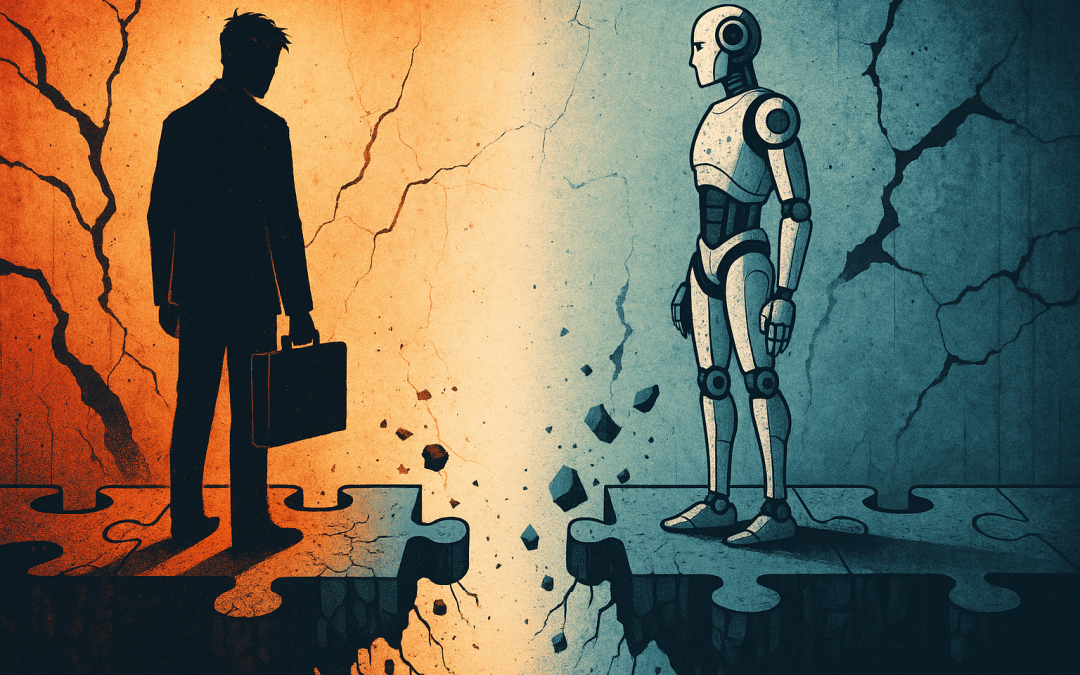
When we talk about artificial intelligence, the conversation often swings between two extremes: wide-eyed optimism about limitless opportunity, or doom-and-gloom predictions about machines taking over. But the real story isn’t either of those—it’s the messy middle.
This isn’t about AI plotting world domination. Machines don’t want power. They don’t care. The danger is much closer to home: the collective collapse of “what we do for a living.”
If AI really does displace 40%–99% of jobs in the next decade, the economy as we know it can’t keep functioning. It fractures, then reforms. But before it reforms, things are going to get rough.
The Short-Term Shock
The first wave is already here. Industries we thought were “safe” are suddenly on shaky ground.
Actors and Writers: Hollywood unions went on strike because studios proposed scanning background actors once and using their likeness forever. Writers worried about AI-generated scripts replacing them. For them, AI isn’t an experiment. It’s a paycheck killer.
Software Engineers: Silicon Valley giants are quietly reducing headcount because one engineer with AI can now do the work of three or four. Entry-level positions—the traditional on-ramp to the industry—are shrinking.
Musicians: Generative tools like Suno and Udio create full-length songs in seconds. Musicians who once relied on royalties from jingles or background tracks are watching machines eat their market.
Customer Support and Admin: Chatbots and virtual assistants are replacing call centers at banks, airlines, and retailers. Routine admin tasks are vanishing as AI systems handle scheduling, invoicing, and HR queries.
The human cost is obvious: households lose stable income. But the ripple effect is broader. When one industry cuts workers, the shockwaves spread. A gas station with fewer attendants means fewer deliveries for truck drivers, less business for insurance agents, and even lower demand for the snack companies stocking its shelves. Every lost paycheck pulls down the ecosystem around it. Consumer spending drops. Families cut back. Local economies shrink. And yet GDP numbers may still look fine, because AI-driven companies remain “productive.”
That’s the paradox: on paper, growth continues. On the ground, people feel poorer.
The Productivity Paradox
AI makes businesses more efficient than ever. But fewer humans get paid for the output.
A small business owner might replace a marketing team with one AI-powered assistant.
A law firm might reduce its junior staff because AI can draft contracts.
A hospital might automate diagnostics, reducing demand for entry-level technicians.
From the outside, everything looks great. Corporate profits rise. Productivity soars. But if fewer people draw paychecks, who’s left to buy the products and services these companies produce?
This paradox isn’t new. The Industrial Revolution increased output, but wages stagnated for decades. Back then, unions, strikes, and new policies eventually rebalanced the system. The same tug-of-war is coming with AI.
Why “Start Your Own Business” Isn’t Enough
It’s tempting to say the solution is simple: if your job disappears, just start your own business. And yes, entrepreneurship will grow. But the economy can’t survive if everyone is a boss and nobody is a worker.
A restaurant can’t function without cooks and servers. A hospital can’t run with only administrators and consultants. Even if AI takes over some tasks, society still needs people who are willing to work in essential roles.
The danger is creating an economy where the only choices are:
Own the AI and prosper, or
Get displaced and struggle.
That kind of split doesn’t just cause inequality. It causes instability.
Systemic Shifts: The Pressure Cooker
When displacement reaches a tipping point, governments and markets won’t be able to ignore it. Several scenarios are likely:
Universal Basic Income (UBI): Countries may experiment with paying citizens a baseline income funded by AI-driven productivity. Small-scale trials already exist in places like Finland and California.
Automation Taxes: Corporations that replace human workers with AI could be required to contribute to safety nets. Bill Gates has argued for this, though it faces fierce opposition.
Shorter Work Weeks: If one human plus AI can do five people’s work, spreading hours across more workers could maintain employment levels while keeping businesses efficient.
Each of these solutions comes with political fights and practical challenges. But the pressure will force action. History shows us that when inequality becomes unbearable, systems bend—sometimes violently.
The Big Redefinition: Beyond Labor
For centuries, the economic model has been straightforward: you work, you earn, you spend. That cycle keeps everything moving.
AI breaks that link. When machines handle the majority of tasks, “work” is no longer the engine of survival. The economy begins to shift toward:
Ownership: Who owns the AI models, platforms, and intellectual property?
Creativity: Who can generate new ideas, products, or cultural movements?
Contribution: Who builds trust, relationships, and communities that AI can’t replicate?
The winners won’t be defined purely by job titles. They’ll be defined by whether they control or creatively apply the new tools.
The Messy Middle: What Collapse Looks Like
Let’s not sugarcoat it. The middle part of this transition is going to be ugly.
Protests and Strikes: Hollywood was only the beginning. Expect truckers, teachers, healthcare workers, and coders to push back.
Lawsuits Everywhere: Who owns the output of an AI trained on copyrighted work? Courts are drowning in cases from authors, artists, and musicians.
Clone Hacks: As more people build digital replicas of themselves to scale their work, hackers will exploit them. Imagine your AI clone calling your clients with a scam.
Deepfake Damage: Politicians, executives, and everyday people are already seeing reputations ruined by synthetic media.
The Have/Have-Not Divide: Those who adapt quickly to AI thrive. Those who can’t get left behind. The middle class—the stabilizing force of modern economies—erodes.
That’s what collapse looks like. Not robots rising up, but humans fighting over who gets to eat.
Navigating the Messy Middle
So how do we survive the turbulence between collapse and reinvention? Here’s a framework:
1. Protect
Guard your digital identity.
Diversify your income streams, even modestly.
Protect your mental health.
2. Adapt
Don’t reject AI—learn to use it.
Keep learning. Curiosity beats static expertise.
Strengthen your network. Opportunities flow through people.
3. Contribute
Look for work that reinforces empathy, trust, and creativity.
Participate in your community. Belonging outlasts industries.
Think about shared prosperity, not just survival.
What About Small Businesses?
It’s not just employees who feel the ground shifting. If you already own a business—whether it’s an online store, a coaching practice, or a service business like accounting or virtual assistance—you’re navigating the same storm from a different angle.
For some, AI feels like a gift. It makes marketing easier, content creation faster, customer service cheaper. The tools that once required agencies and big budgets are suddenly accessible to anyone with a laptop.
But here’s the trap: if you only use AI to cut costs, you risk shrinking instead of scaling. When every competitor is using the same tools to generate the same blogs, ads, and graphics, you blend into the noise. Efficiency alone won’t save you.
The real opportunity for small businesses lies in two things:
Differentiation — Pair AI with your unique expertise, personality, and relationships. AI can draft an email, but it can’t replicate the trust you’ve built with your clients.
Creation, not just curation — Many small businesses—retailers, resellers, realtors—don’t make their own products. They rely on arbitrage, access, or margin. But when AI flattens information and comparison shopping becomes instantaneous, middle layers get squeezed. To survive, you need to add new value: education, community, or experiences that go beyond “I sell what others also sell.”
The Coming Squeeze for Middlemen
Retailers who resell the same products others carry will feel pressure as AI shopping agents scour the internet for the lowest price. Realtors who don’t own inventory already face platforms where AI can filter homes, schedule tours, and handle paperwork. Accountants and virtual assistants may see clients asking why they should pay human rates when software promises the same service for a fraction of the cost.
That doesn’t mean these businesses disappear. It means the bar rises. The businesses that thrive will be the ones that layer human value on top of AI efficiency—personal guidance, empathy, creativity, local expertise, niche specialization.
A coach who clones themselves with AI to scale, but still offers one-on-one conversations that matter.
An accountant who automates bookkeeping, but spends freed-up time on strategic tax planning.
A retailer who uses AI-driven personalization, but also hosts real community events no algorithm can replicate.
Small business owners can navigate these times by asking a simple question: If AI makes my service cheaper or more common, what extra layer of humanity can I add that makes me indispensable?
That’s not about fighting the tide. It’s about surfing it.
What If the System Itself Breaks?
Here’s the hardest question: what if AI’s disruption isn’t something we can “adjust” to in the usual ways? What if this isn’t just another industrial revolution, but something bigger?
Consider:
If musicians, actors, and writers can be replaced by AI, what happens to culture itself?
If engineers, coders, and analysts can be replaced, what happens to innovation?
If clones can be hacked and deepfakes weaponized, what happens to trust?
At some point, we may have to rethink not just the economy, but the foundation of society. If labor no longer defines us, then identity, contribution, and meaning will have to take its place.
That’s the deeper challenge of the messy middle.
The Human Response
Machines don’t crave power. But humans do. Which means this isn’t really a battle between people and AI. It’s a battle between people and other people—over how AI gets used, who benefits, and who gets left out.
We can let the messy middle divide us into winners and losers. Or we can use it as a chance to redesign systems so more people thrive.
The path forward isn’t about pretending disruption won’t hurt. It’s about admitting it will—and choosing to navigate it together.
The Bottom Line
AI is not conspiring to overthrow humanity. It’s not secretly plotting to enslave us. The real disruption is economic, social, and psychological. It’s the unraveling of the deal we’ve lived with for centuries: you work, you earn, you spend.
That deal is breaking. First comes pain. Then comes reinvention. This is the messy middle, and it will feel chaotic, unfair, and unstable.
But humans have been here before. We rioted over looms, struck over assembly lines, and clashed over the internet. Every time, the messy middle gave way to new systems. The question is whether we’ll learn fast enough this time to avoid the worst damage.
The economy can’t function if everyone is a founder and no one is a worker. But it also can’t survive if we cling to outdated roles that machines now perform better.
So the task isn’t to resist AI or blindly embrace it. The task is to navigate the messy middle—protecting ourselves, adapting our skills, and contributing in ways machines can’t.
Because machines may reshape the economy. But only humans can decide what that economy is for.
A Personal Reflection: Building in the Midst of the Mess
I need to be honest. Writing this isn’t just an intellectual exercise for me—it’s personal.
I’ve been building AI systems for years. My tools help businesses grow, cut through noise, and scale in ways that once required huge teams. I’m proud of the work. I believe in it. But I’d be lying if I said I don’t wrestle with the consequences.
Because every time I help a business owner multiply their output with AI, I know what that means: some of the work that used to take three people now takes one. Every time I create a system that automates routine tasks, I know it shifts what “having a job” means for someone else.
And here’s the part that keeps me up at night: I’m contributing to the very disruption I’m warning about.
How do I reconcile that? How do I sleep at night knowing I’m both helping and, in some ways, hurting?
The answer I’ve come to is this: disruption is inevitable, but destruction isn’t. The loom displaced weavers. The assembly line displaced factory hands. The internet displaced whole industries. And every time, society adapted—not without pain, but with reinvention.
I can’t stop the tide of AI. None of us can. But I can decide how I build. I can design systems that amplify people rather than erase them. I can teach others how to use AI not just to cut costs, but to create value. I can write and speak openly about the dangers instead of pretending they don’t exist.
I don’t believe AI is the end of human contribution. I believe it’s the beginning of a deeper question: What does it mean to be human when machines can do almost everything else?
Maybe that’s where my role fits. Not just as a technologist, but as a guide. To help people see both the risks and the opportunities. To remind them that AI doesn’t care, but humans do—and we still get to choose what kind of future we build with it.
So yes, I’m contributing to the mess. But I’m also committed to helping us navigate it. If I can do that, then I can sleep at night.
And if this article made you stop and think, I’d invite you to go deeper with my book Bluff: How AI Called Humanity’s Hand. It’s where I explore not just the disruption, but the possibilities on the other side of the messy middle.





 Guest Posting

