
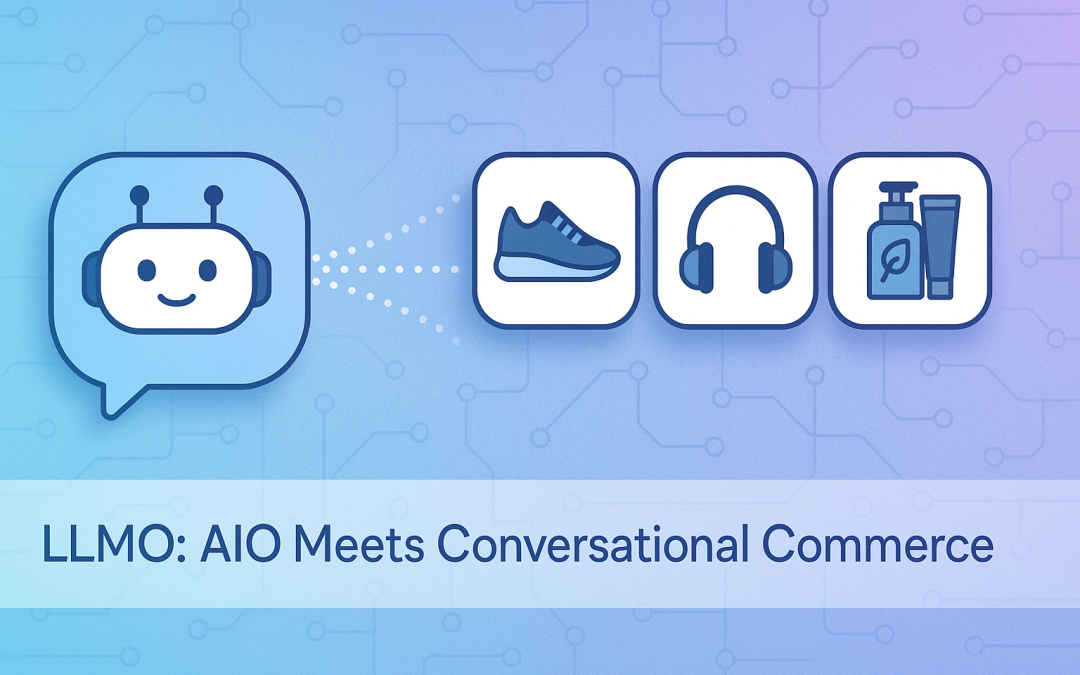
AIO, short for AI Optimization, marked the start of a major shift in how people discover products online. It wasn’t hype—it was the beginning of something real. But things just accelerated again.
Thanks to OpenAI’s newest update and a growing wave of “agentic AI” that shops on your behalf, we’re entering a whole new era. One where your customer doesn’t even see your store. They talk to a digital assistant, and it makes the buying decision for them.
This isn’t theoretical. It’s already happening.
We’re moving past keyword-based SEO and even past AIO. Welcome to the world of LLMO—Large Language Model Optimization—where AI decides what products to recommend based on conversations, context, and confidence. And as if that weren’t enough, now we’re staring down a future where autonomous AI agents won’t just recommend your product—they’ll buy it. Or not.
And here’s the uncomfortable truth: most ecommerce businesses aren’t ready.
ChatGPT Is Now a Shopping Assistant
On April 28, 2025, OpenAI rolled out something that quietly rewired how online shopping works: shoppable product cards, embedded directly in ChatGPT.
Forget keywords. Forget search ads. Forget even landing pages for a moment.
Ask ChatGPT a question like, “What’s the best carry-on suitcase under $150 that’s good for international flights?” and instead of giving you a link to a blog post, it shows you product cards with:
Real-time pricing
Availability
Customer reviews
Product photos
A “buy now” link
It’s all happening inside the conversation—frictionless, fast, and deeply relevant.
ChatGPT is no longer just answering your question. It’s completing your task.
And while this is huge for consumers, it also signals a wake-up call for online retailers. Because if your products aren’t being shown in these conversations, someone else’s are.
Your Store Is Either in the Conversation—or It’s Not
Unlike traditional search engines that rely on keyword ranking, ChatGPT pulls in products using its OAI-SearchBot, an AI crawler designed to scan online stores for structured data. Even better: OpenAI now allows retailers to submit product feeds directly.
That means you now have a pipeline to get your products in front of 400+ million monthly users—and over a billion queries per week.
But there’s a catch.
ChatGPT doesn’t care about your ad budget or your brand equity. It cares about relevance, clarity, and structured product data.
And that’s where most ecommerce sites are asleep at the wheel.
Enter: Agentic AI (a.k.a. Bots That Buy)
While conversational shopping via ChatGPT is a big leap forward, it’s just the beginning. The next stage? Agentic AI. That means digital assistants that don’t just suggest what to buy—they actually place the order.
That’s where things get real.
Forbes recently published a warning shot disguised as an article: agentic AI will change shopping forever—and not in your favor unless you prepare now.
These autonomous agents will:
Compare products across retailers
Evaluate price, shipping speed, and customer reviews
Decide what to buy
Place the order
Do it all without your site ever showing up in a browser
Your product either fits the agent’s filters, or it’s invisible.
In other words, your next customer might be a bot. A very picky one.
Why This Should Shake Every Online Retailer Awake
Let’s break down why this changes everything:
1. Brand Loyalty? Not to Bots.
Agentic AIs don’t care about your logo, your story, or your social media presence. They care about data points: price, speed, reviews, reliability. That’s it.
If you’ve built your business on branding, that’s not a bad thing. But it’s no longer enough. The AI agent doesn’t feel nostalgic. It just buys what checks all the boxes.
2. The New SEO Isn’t About Keywords
You’re not optimizing for a search engine anymore. You’re optimizing for conversations. For decision-making algorithms.
That means:
Conversational product descriptions
Natural language metadata
Review-rich product pages
Call it LLMO—Large Language Model Optimization. It’s what AIO just evolved into.
3. The Middle of the Funnel Just Collapsed
Traditionally, shoppers move from awareness to interest to decision in a funnel. But when an agent or chatbot gives them a product that fits their needs, that entire middle of the funnel disappears.
One conversation = one decision.
That means:
Less time to build rapport
No room for bloated landing pages
Zero tolerance for friction
If your data isn’t clean, complete, and compelling—you’re out.
4. Democratized Opportunity (If You’re Ready)
Here’s the upside: without ad dollars distorting results, smaller retailers have a shot at competing. The AI doesn’t care how big your store is—only whether you have the product that best fits the request.
But to compete, you need to feed the machine what it needs.
What You Need to Do Right Now
Here’s your checklist to get ahead of this shift:
✅ 1. Allow AI Crawlers Access
Make sure your site isn’t blocking OpenAI’s OAI-SearchBot. In your robots.txt file, include:
If you’re on Shopify, WooCommerce, or BigCommerce, you may need to consult your platform’s support.
✅ 2. Submit Your Product Feed to OpenAI
Go here:
https://openai.com/chatgpt/search-product-discovery/
Upload your product feed. If you already use one for Google Shopping, you’re almost there. Clean up your data. Include:
Titles
Prices
Inventory
Images
Reviews
Descriptions with natural language
✅ 3. Revamp Product Descriptions for LLMs
Forget keyword stuffing. Think human. How would a customer ask for this product in real life?
Example:
❌ “High-density foam yoga mat, 1/4 inch, blue”
✅ “Great for beginners, this budget-friendly yoga mat cushions knees and rolls up easily for travel.”
That second one? LLMs eat it up.
✅ 4. Double Down on Reviews
Authentic, user-generated reviews aren’t just social proof anymore—they’re training data.
Encourage your customers to write reviews that mention:
Use cases
Who it’s good for
What they liked or didn’t
This language gets indexed and helps the AI match your product to real-world questions.
✅ 5. Think Like a Bot
If you were an AI agent trying to buy the best value item, you’d want:
Fast delivery
Accurate stock levels
Competitive price
Return policy
Clear product specs
Now go through your site with that lens. Does your product page answer the bot’s unspoken questions?
✅ 6. Prepare for Voice and Agent-Based Commerce
OpenAI is already testing always-on assistants and hardware. That means we’re not far from:
“Hey assistant, order me an ergonomic chair under $200 with good back support.”
And boom—the transaction is complete without ever visiting your website.
If your product feed doesn’t speak the language of that request, it won’t get surfaced.
The Bigger Picture: This Isn’t About AI. It’s About Control
What we’re seeing is the platform-ification of the shopping experience. Just like social media replaced the homepage for many businesses, AI could replace the store entirely.
People aren’t searching anymore—they’re asking.
They’re not browsing—they’re choosing from filtered results.
They’re not comparing your branding—they’re relying on a bot to decide for them.
So What’s the Future of Ecommerce in an AI World?
A few things to expect:
Fewer customer touchpoints → You have less time to make an impression.
More invisible buyers → Decisions made without your input.
Less emphasis on ads → AI doesn’t prioritize who paid the most.
More demand for quality data → Structured, accurate, real-time.
The winners will be those who can adapt their backend as fast as they adapt their branding. It’s not about being louder—it’s about being clearer, faster, and easier to buy.
Final Thoughts: Don’t Be Left Behind
This isn’t the beginning of a trend. This is the middle of a revolution. You’re already behind if you’re not showing up in AI search.
But the good news? You can still catch up.
Start with your product feed. Fix your metadata. Rewrite your descriptions. Invite reviews. Test your presence inside ChatGPT.
Then ask yourself: if a bot came shopping today, would it buy from you?
Because ready or not, that’s who’s browsing your store next.
Want help getting your store LLMO-ready? Let’s talk.







 Guest Posting

