
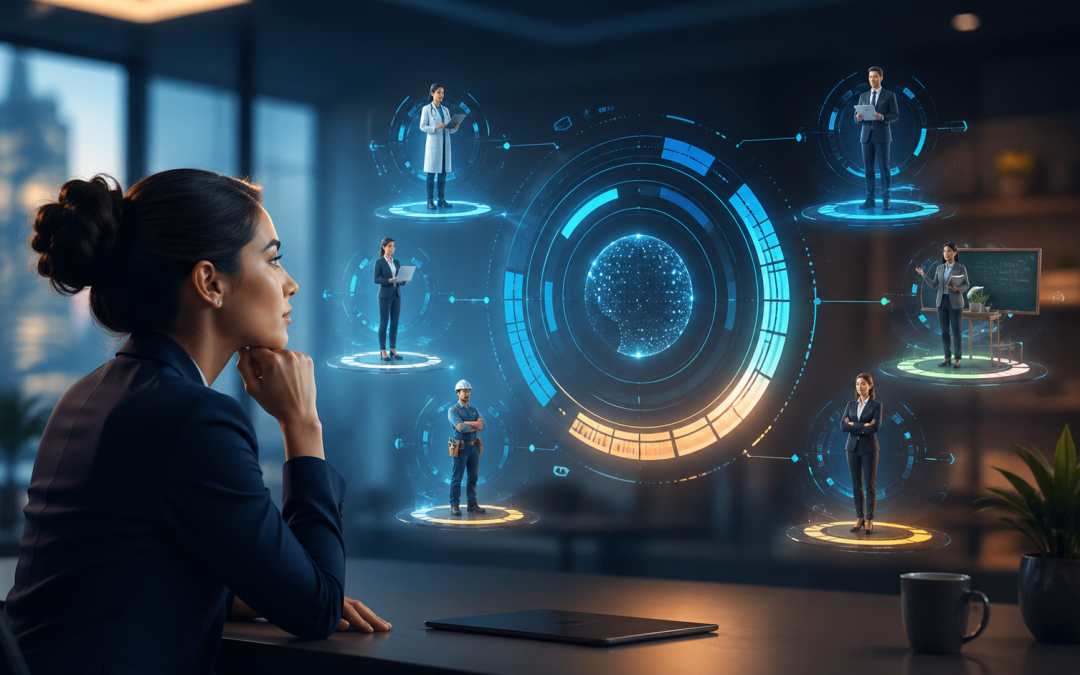
There is a moment happening right now that most people can feel, even if they cannot quite explain it.
Something about work is changing.
Not in the dramatic, overnight way headlines sometimes suggest. More like a slow shift in the background. Teams are smaller. Expectations are higher. Tasks that used to take hours now take minutes. Decisions that once required specialists are being assisted by software.
And almost everyone is asking some version of the same question:
What does this mean for my job?
For years the conversation around artificial intelligence and employment has been theoretical. Panel discussions. Predictions. Think pieces about what might happen someday.
But I started noticing something different.
People were no longer asking about the future of work in general. They were asking about their own future. Their own income. Their own career path.
So I decided to build a tool to make the conversation more concrete.
Turning Anxiety Into a Number
The idea was simple.
What if you could evaluate any profession and estimate how exposed it might be to artificial intelligence?
Not to create fear. Not to declare winners and losers. But to give people a clearer lens for thinking about change.
The tool looks at the structure of work itself.
How much of it happens digitally.
How repetitive the tasks are.
How much human judgment or trust is involved.
Whether the job requires physical presence in the real world.
From there it produces a score that helps answer a very practical question:
Is artificial intelligence more likely to replace parts of this work, or assist the person doing it?
That distinction matters.
Because most industries are not disappearing. They are evolving.
What the Scores Tend to Reveal
When you run different careers through the analyzer, patterns begin to emerge.
Roles built around routine digital tasks often show higher exposure. Work that involves summarizing information, generating content, or processing data is increasingly influenced by AI systems.
Meanwhile professions that depend on real-world interaction, manual skill, or deep personal relationships tend to show lower exposure. Not immune. Just different.
The interesting part is what happens in the middle.
Many jobs fall into a gray zone where artificial intelligence does not eliminate the role, but changes how it is performed. Doctors use AI to analyze scans. Lawyers use it to review documents. Entrepreneurs use it to research markets or draft campaigns.
The work still exists.
The workflow evolves.
Why This Matters Now
Putting a number on something as personal as career risk changes the tone of the conversation.
It moves the topic from abstract predictions to individual awareness.
People stop debating trends and start asking practical questions.
What parts of my job are vulnerable?
Where can I become more valuable?
How do I adapt without completely reinventing myself?
These are healthier questions than panic about whether jobs will vanish overnight.
Historically, major technology shifts have not simply erased professions. They have reshaped them. When spreadsheets arrived, accountants did not disappear. When the internet arrived, journalism did not end. Instead, new skill sets emerged and new opportunities followed.
Artificial intelligence appears to be following a similar path.
A Tool for Clarity, Not Fear
The goal of this analyzer is not to predict doom or promise safety.
It is to create clarity.
A high exposure score does not mean a career is over. It means certain tasks are likely to change. A lower score does not guarantee stability. It means the work may be influenced in different ways, such as productivity expectations or pricing pressure.
In many cases, the most powerful outcome is realizing that artificial intelligence can become a collaborator rather than a competitor.
Professionals who understand how to integrate new tools into their workflow often discover they can deliver better results, serve more clients, and focus more on the uniquely human aspects of their work.
What Your Score Really Tells You
At its core, the analyzer is less about technology and more about awareness.
It encourages people to look at their career through a structural lens.
Is your value tied primarily to tasks that can be automated?
Or is it rooted in experience, creativity, judgment, and trust?
Those distinctions will shape how different industries evolve over the next decade.
And while no tool can predict the future perfectly, understanding the direction of change can help professionals make smarter decisions today.
The Future Is Personal
One of the most fascinating aspects of artificial intelligence is that its impact is not uniform.
Two people in the same industry may experience it very differently depending on how they choose to respond. Some will resist until change is forced upon them. Others will experiment early and discover new ways to grow.
The analyzer is simply a starting point for that reflection.
Because the real question is not whether AI will affect work.
It already is.
The more important question is how each of us chooses to adapt.
Have you explored what your own career exposure might look like?
The answer can be surprisingly empowering.







 Guest Posting

