
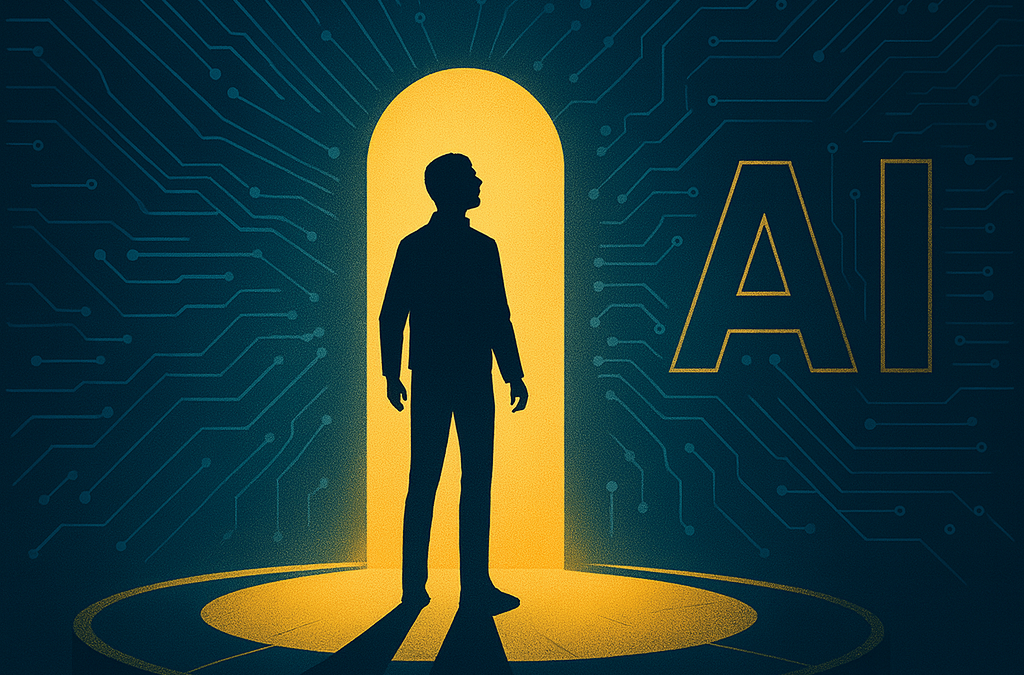
Artificial Superintelligence — ASI — is no longer a far-off concept. We’re not just training machines to help with emails anymore. We’re training them to learn faster than us, code better than us, and eventually think beyond us. Some experts say five years. Some say two. Either way, once we cross that line, everything changes.
And yes, the numbers are staggering: 40% of jobs projected to vanish by 2027. By 2030, AI could eliminate nearly every traditional role where the work is moving information from one place to another. Admin, sales, finance, middle management—if your job can be done with a prompt, it will be.
But here’s what those headlines miss: This is the most exciting time in human history to build something of your own.
If you’re feeling anxious about AI, you’re not wrong. Fear of losing your livelihood isn’t paranoia—it’s reality. But fear doesn’t have to be the final word. Fear is the starting line. Share on XThe End of Gatekeepers
For the first time ever, you don’t need permission to start.
You don’t need a wealthy investor to believe in your vision. You don’t need to rent expensive office space or hire a team of twenty before you can launch. You don’t need to live in Silicon Valley or know someone who knows someone.
With a laptop and a few smart AI tools, you can:
- Create professional content that rivals agencies
- Design products and prototypes in hours, not months
- Automate customer support so you never miss a query
- Run sophisticated marketing campaigns without a marketing degree
- Generate passive income streams while you sleep
The barriers that kept ordinary people from building extraordinary things? They’re gone. Capital, geography, gatekeepers—none of it matters anymore. What matters is whether you’re brave enough to start.
The Fear Is Real. So Is the Opportunity.
Let’s be honest: this moment is terrifying. For many of us, work isn’t just what we do; it’s who we are. Losing a paycheck is one thing. Losing your sense of purpose is another. When technology advances faster than society can adapt, people get crushed in the gears.
There’s a story we’ve told ourselves for generations: if you study hard, work hard, and stay loyal to your employer, you’ll be rewarded with stability. AI has shattered that story. For the first time, we’re not competing against cheaper labor overseas—we’re competing against something that doesn’t sleep, doesn’t eat, doesn’t take sick days, and doesn’t need health insurance.
It’s easy to panic. To freeze. To lash out at the technology.
But here’s a different way to look at it: What if this disruption is exactly what needed to happen?
The Psychology Flip
Some people call using AI “cheating” or unethical. But if AI can save your clients money, if it can give them a better product or faster service, then aren’t you doing them a disservice by not using it?
That’s the psychological flip we all need. Instead of asking, “What if AI takes my job?” the question becomes, “What if AI can make me unstoppable?”
Because here’s what’s really happening: while everyone else is paralyzed by fear, a small group of people are using this exact moment to build empires. They’re launching businesses. Creating products. Building audiences. Generating wealth.
AI will create more millionaires in the next five years than the internet did in the last twenty.
The question is: will you be one of them?
History Doesn’t Repeat, But It Rhymes
Every major disruption in history has wiped out jobs. The loom destroyed the weaver’s craft. The assembly line displaced factory hands. The internet made travel agents and phone book advertisers irrelevant. But each wave also created roles no one could have imagined—social media managers, app developers, UX designers, drone pilots.
The same will happen in the AI era. New opportunities are already emerging. But here’s the part they don’t tell you: the people who thrive won’t be the ones waiting for new jobs to appear. They’ll be the ones creating them.
This isn’t just an economic shift. It’s a human one. And it’s asking you a question: Are you going to wait for someone to hire you, or are you going to build something that can’t be automated away?
Playing Small vs. Building Empires
Business owners love to brag about how they’re using AI:
- “We cut staff—AI writes our emails.”
- “We’re saving money—AI handles our blogs.”
- “AI runs our ads—we don’t need a team anymore.”
And sure, they save a little money. But they’re not growing. They’re shrinking. Because AI doesn’t just take jobs from workers—it steals traffic, visibility, and customers from the businesses that play it small.
Smart people use AI to work less. Brilliant people use AI to earn more.
The real opportunity isn’t in cutting costs. It’s in multiplying your output. Scaling your reach. Serving more customers. Creating more value. Building something that matters.
One person with AI can now do what used to take a team of ten. That’s not a threat. That’s a superpower.
The Truth About AI That No One Wants to Say
We assume that because something is smart, it must also be ambitious. That if it can outthink us, it will naturally seek to overpower us.
That assumption says more about us than about machines.
Humans want power. We fight wars, climb hierarchies, and protect status. We’re the ones who plot, scheme, and conspire. Intelligence, on its own, doesn’t do that. As Yann LeCun put it, “Intelligence does not automatically want power.”
When we say LLMs are just autocomplete machines, we’re also saying something important: they don’t care. They don’t want. They don’t plot. They respond.
The simple truth is that AI isn’t secretly conspiring against us. It doesn’t want power. It doesn’t care about overthrowing humanity. It’s a tool. The most powerful tool we’ve ever created. And like any tool, it amplifies the intentions of whoever wields it.
So the question isn’t whether AI is dangerous. The question is: What do you want to create with it?
What Makes You Irreplaceable
Here’s what machines will never take from you: the ability to decide what matters.
Machines can generate a song. Only humans can feel the way that song lands.
Machines can draft a business plan. Only humans can inspire a team to rally behind it.
Machines can produce art. Only humans can decide what’s worth creating in the first place.
We get to redefine what it means to be human. That doesn’t mean “try harder to keep up with machines.” It means leaning into the things only we can do: creativity, empathy, trust, judgment, relationships, community, vision.
The future doesn’t belong to people who are afraid of AI. It belongs to people who partner with AI to become more human, not less.
Your Move
First, stop treating AI like the enemy. It’s here, and it’s not going to be un-invented. The question isn’t whether it replaces jobs. It will. The question is whether you’ll let it replace you—or whether you’ll use it to build something that can’t be replaced.
Second, get practical. Start today:
- Use AI to automate the boring stuff that drains your energy
- Use AI to extend your reach—create content, find customers, analyze data
- Use AI to multiply your value, not just cut your costs
- Use AI to launch the business you’ve been putting off for years
Third, lean into what makes you irreplaceably human. Build relationships. Get curious. Learn faster than the fear spreads. Create something that matters to you.
Because here’s the truth: this is the greatest transfer of opportunity in human history.
The playing field has never been more level. The tools have never been more accessible. The potential has never been greater.
You don’t need a trust fund. You don’t need an MBA. You don’t need permission.
You need a vision. A laptop. And the courage to start.
If this feels overwhelming, you’re not alone. That’s exactly why I wrote my book Bluff: How AI Called Humanity’s Hand. It’s a deep dive into the fears, the psychology, and the opportunities of this moment. If this article lit a spark, the book will give you the playbook. Grab a copy and let’s build the future together.
The Future Belongs to the Builders
If you’re reading this while wondering, “But what about me? My job. My bills. My family?”—you’re not alone. The fear is real. The disruption is real.
But so is the opportunity.
This isn’t the end of human contribution. It’s the beginning of the greatest creative explosion in history. A moment where one person with an idea can reach millions. Where you can build, launch, and scale without asking for permission. Where the only thing standing between you and the life you want is the decision to start.
The future belongs to those who stop asking “What if AI takes my job?” and start asking, “What if AI helps me build the life I actually want?”
What if this—right now—is your moment?
What are you going to build?





 Guest Posting

