
The Real Divide Isn’t Human vs. AI — It’s Content vs. Communication
Most people asking “is there still room for editors?” are really asking the wrong question. They’re picturing the old job. Red pen. Grammar fixes. Cleaning up commas.
That job is already gone.
What hasn’t gone anywhere is the need for something AI still struggles with — making content feel like it came from a real human who actually believes what they’re saying.
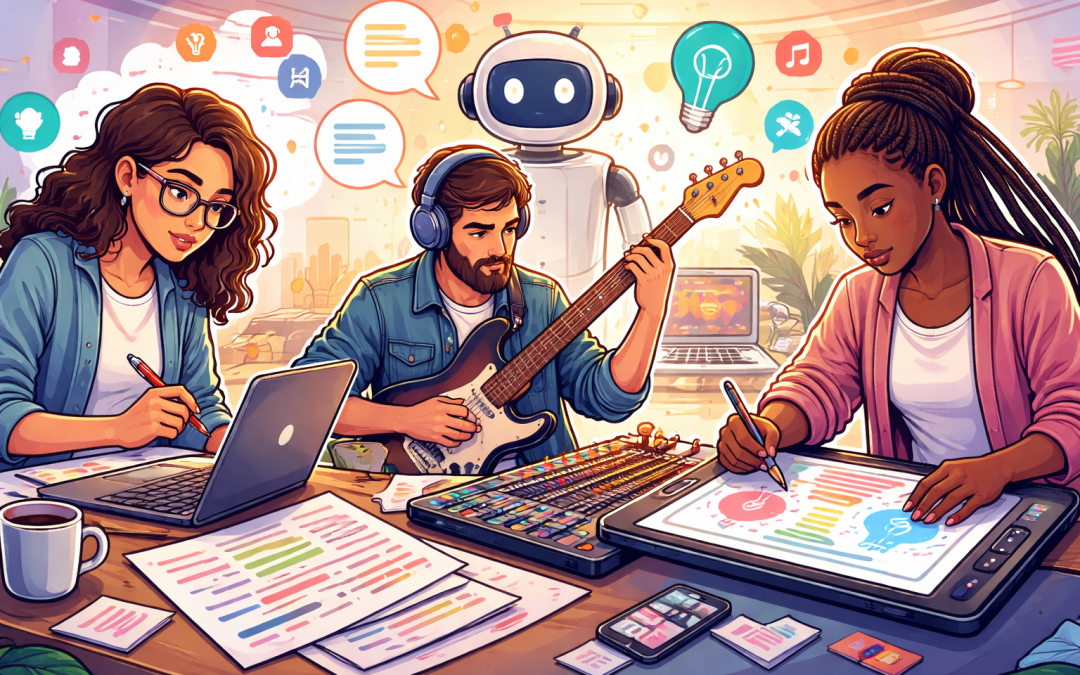
But here’s the thing: this isn’t just an editor question. It’s the same question facing designers, musicians, course creators, coaches, and anyone else whose work involves communicating ideas. The real divide isn’t between humans and AI. It’s between producing content and actually communicating. AI is about to eat one of those alive. The other is about to become more valuable than ever.
The old version of a lot of creative and professional work was fundamentally about production. Writers produced articles. Designers produced layouts. Musicians produced tracks. Course creators produced modules. The output was the point, and the faster and cleaner you could produce it, the more competitive you were.
That game is over. AI produces faster, cleaner, and cheaper than any human can. If production is your value proposition, you’re already in trouble. But production was never the hard part. Communication was — and that’s the part AI still can’t fake.
I was talking with someone recently who told me high school students are using ChatGPT to write essays and turning them in without even reading them. Not editing. Not refining. Not even reviewing. Just generate and submit. That’s not writing. That’s outsourcing thinking. And it’s a perfect example of what happens when you treat communication like production — you optimize for output and lose the thing that made the output matter in the first place.
The Flood of “Good Enough”
I get pitched guest posts all the time. Most of them look fine at first glance — clean structure, clear headings, no typos, everything technically correct. And yet, within a few sentences, you can feel it. It’s flat. That’s what is being called AI Slop.
But this isn’t just a writing problem. It’s everywhere.
Scroll through any design marketplace and you’ll see hundreds of AI-generated logos that are technically polished and completely interchangeable. Listen to AI-generated music tracks and you’ll hear compositions that are structurally sound but emotionally vacant. Browse online courses and you’ll find modules that cover all the right topics in the right order and somehow teach you nothing, because there’s no real perspective behind them.
The pattern is the same regardless of the medium: the output is competent, coherent, and forgettable. It checks every box and moves no one.
AI content follows patterns. It repeats ideas. It circles back to the same point using slightly different words. It plays it safe, avoids strong positions, and rarely risks being wrong. There’s a sameness to it that’s hard to pin down in any single sentence or frame or note, but impossible to miss across a full piece of work.
And then there’s the rhythm problem — in writing, it’s the short-sentence-line-break-short-sentence cadence that makes everything read like a slide deck. In design, it’s the same gradient-and-sans-serif aesthetic that makes every brand look like it launched in the same accelerator. In music, it’s the predictable structure that never surprises you. In courses, it’s the module-quiz-module-quiz format that teaches information without ever transmitting understanding.
Used intentionally, any of these patterns can work. But when the entire output is built from patterns, it stops feeling like communication and starts feeling like assembly.
Communication Has Edges
Here’s what separates content from communication: edges.
Human communication isn’t perfect, and that’s exactly why it works. A great writer wanders a bit, includes a story that doesn’t perfectly support the thesis, admits uncertainty, says something that might not be universally accepted. A great designer makes choices that are intentional rather than safe — a color that clashes slightly, a layout that breaks convention because breaking it makes you look twice. A great musician leaves in the imperfection, the breath, the moment that wasn’t planned. A great coach says something that challenges you instead of something that validates you.
That messiness is what makes communication believable, because real thinking is messy. Real taste is specific. Real conviction means some people will disagree with you.
AI doesn’t do that well. It optimizes for coherence, not conviction. It produces content that’s technically solid but emotionally empty — the professional equivalent of a smile that doesn’t reach the eyes.
Right now, there’s a lot of it. And there’s about to be a lot more.
The Judgment Layer
So where does this leave the humans?

Not where most people think. The opportunity isn’t in competing with AI on production. It’s in becoming the judgment layer — the person who looks at what AI produces and knows whether it actually communicates anything.
This applies across every field that’s being reshaped by AI.
For writers and editors, it means taking structured, optimized, technically correct content and turning it into something that sounds like a conversation instead of a report. It means knowing when to leave something imperfect because the imperfection makes the piece stronger, when to vary the rhythm, when to let a paragraph run long so the next short line actually hits.
For designers, it means taking AI-generated visuals and injecting a distinct identity — a point of view, a brand that actually feels like something specific rather than something generically professional. Anyone can generate a logo now. Fewer people can look at it and know whether it says anything worth saying.
For musicians, it means using AI as a starting point but layering in real emotion, unexpected choices, and the kind of imperfections that make a track feel like a human made it because they had something to express, not because they needed to fill a playlist.
For course creators and coaches, this might be the most important shift of all. A course built on AI-generated content can cover every topic in the right sequence with perfect clarity and still fail to teach anyone anything meaningful. Because learning doesn’t happen when information is transferred. It happens when someone communicates an insight in a way that changes how you think. That requires a point of view. It requires the willingness to say “here’s what I believe and why” instead of “here are the seven best practices.” It requires the courage to be specific, even at the cost of being universal.
The people who can do that — in any medium — aren’t competing with AI. They’re completing it.
The Difference Is Subtle — Until It Isn’t
Most people won’t be able to explain why one piece of work feels better than another. But they feel it.
They’ll skim one article and forget it before they close the tab. They’ll watch a course module and retain nothing. They’ll glance at a brand’s visual identity and feel nothing. Then they’ll encounter the other version — rougher, maybe, less polished in places, but alive with something real — and they’ll stay with it.
That gap between content that’s correct and communication that connects is where the value lives. And it’s not something you can fully automate, because the whole point is that it resists automation. The value comes from judgment, from taste, from the willingness to make a choice that a machine wouldn’t make because a machine doesn’t have anything at stake.
Content vs. Communication
There’s a popular narrative that anything a machine can do will eventually be done faster, cheaper, and better. In many cases, that’s true.
But it confuses production with communication.
Machines are great at producing output. They’re getting better at it every month, across every medium. But producing output and communicating meaning are fundamentally different activities. Meaning comes from experience, from opinions that carry weight because someone earned them, from stories that don’t fit neatly into a template, from the willingness to say something that might not be perfectly optimized but is actually true.
That’s not a skill that’s shrinking. That’s a skill that’s becoming scarce.
The Bottom Line
There’s more content being created right now than at any point in history — written, visual, audio, video, educational — and most of it is clean, competent, and forgettable.
The people who can take that content and turn it into real communication aren’t going away. They’re becoming the most valuable people in the room.
Not because they can write perfectly.
But because they know when not to.






 Guest Posting

