
TL;DR:
|
Years ago, Elon Musk said artificial intelligence could be more dangerous than nuclear weapons. He put it on Twitter first, back in 2014, calling AI “potentially more dangerous than nukes,” and by 2018 he had dropped the qualifier altogether, telling a crowd at South by Southwest that AI was “far more dangerous than nukes. Far.” A lot of people thought he was being dramatic, and maybe he was. Musk has never been in the business of small predictions.
But here is the part that should stop you. Musk is not some lone crank yelling from the cheap seats. The people who actually built this technology have been saying the same thing, and saying it louder every year. Geoffrey Hinton is called the godfather of AI for a reason, because the neural network work that earned him a Turing Award and then the 2024 Nobel Prize in Physics is the foundation under nearly every system we now call artificial intelligence. In 2023 he walked away from Google so he could speak freely about the risks of the thing he helped create, and he has since warned that AI could drive massive unemployment while funneling the gains to a handful of people at the top. He is not alone. In May of 2023, the chief executives of the three leading AI labs, OpenAI, Google DeepMind, and Anthropic, joined Hinton and hundreds of other researchers in signing a single sentence declaring that reducing the risk of human extinction from AI should be a global priority on the same level as pandemics and nuclear war. The people racing to build it signed a statement comparing it to the bomb. Let that sink in.
So when I add my voice to this, understand that I am not standing outside the building throwing rocks. I am standing inside it. And I think most of those warnings, as serious as they are, still point at the wrong danger. They tend to focus on the dramatic version, the machine that becomes smarter than us, decides we are inefficient, and turns on its makers. That makes for a good movie. I do not think it is the real problem, because the real problem does not require any of that. The machine does not want power. People do. And that is the part worth losing sleep over.
A machine doesn’t need ambition, or greed, or hatred, or ideology to become dangerous. It doesn’t need to be angry with us, and it certainly doesn’t need to want to rule the world. It only needs to be useful to the people who do. That is a much lower bar, and we cleared it a long time ago.
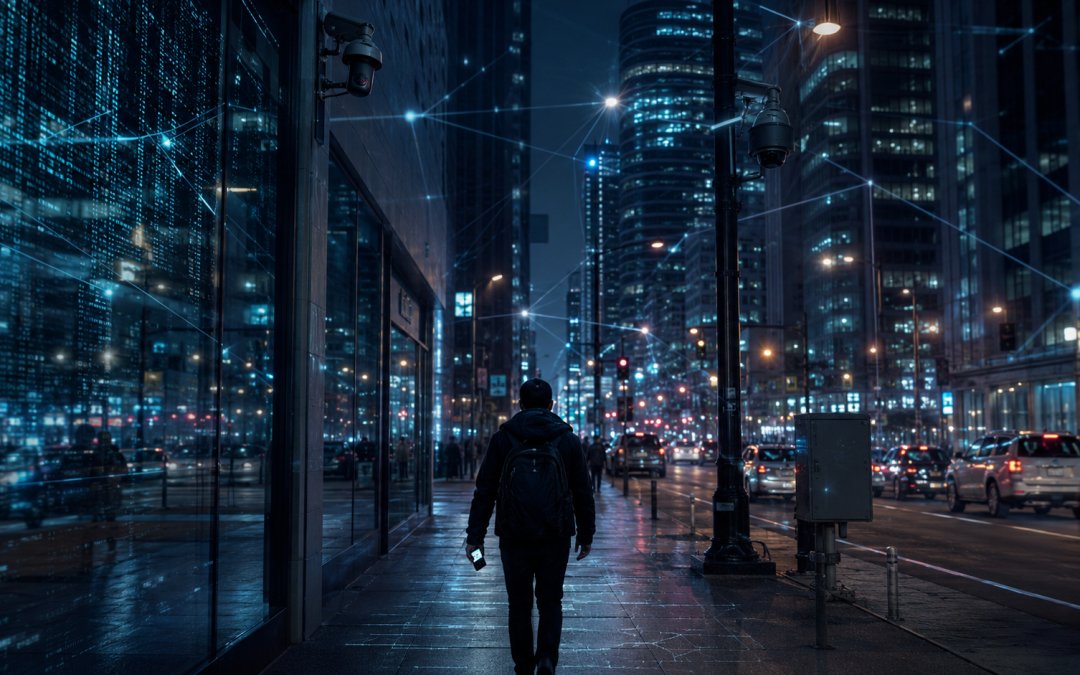
Here is what makes a nuclear weapon terrifying: everyone understands exactly what it does. It destroys in a flash, it leaves a crater, and it announces itself with fire and radiation. AI doesn’t work that way. It doesn’t have to explode. It sits quietly inside the systems we already use every day, the cameras on the light poles, the plate readers at the intersections, the phone in your pocket, the speaker in your kitchen, the loyalty card in your wallet, the search bar, the social feed, the banking app, the doorbell camera. There is no mushroom cloud and no siren. There is just a record. A timestamp, a location, a face, a plate, a purchase, a search, a message. One pattern, then another, then another. And one day, with no announcement at all, ordinary life becomes searchable.
If that sounds like science fiction, it isn’t, and there is already a company that proves it. A firm called Clearview AI quietly scraped more than thirty billion photographs of people’s faces off social media and the open web, without asking a single one of them, and built a facial recognition engine on top of it. You almost certainly never heard of them until a New York Times investigation pulled back the curtain in 2020, and your face is very likely in their database right now, because if your photo has ever been public on the internet, it qualified. They sell that engine to law enforcement, to Immigration and Customs Enforcement, to the FBI, and to thousands of local police departments. Regulators across Europe, in France, Italy, the Netherlands, and the United Kingdom, have ruled the whole operation illegal and hit the company with fines running into the tens of millions. Clearview has largely shrugged and kept going, because nobody has figured out how to enforce a fine against a company that simply ignores it. As the Dutch privacy regulator put it when it levied its penalty, this is not a doom scenario from a scary film, and it is not something that only happens in China. It already happened. To you.
That word, searchable, is the one most people skip right past. Most of us still picture surveillance as somebody watching us, a person, a detective, some tired government employee behind a wall of monitors drinking bad coffee at two in the morning. That is the old model, and the old model is dead. The new model does not require anyone to watch everyone. It only requires enough sensors, enough storage, enough algorithms, and enough access. Then the system watches for them.
For most of the history of surveillance, that was actually a comfort, because all that collected data was clumsy. Governments and corporations could vacuum up enormous amounts of information, but making sense of it was slow and expensive. Somebody had to organize it, somebody had to search it, somebody had to connect the dots, and there were never enough somebodies. AI is what changed that. AI can connect dots no human being would ever have the time to connect. It can summarize years of your behavior in seconds, infer the things you never actually said, predict where you are likely to go next, and build a psychological profile out of crumbs: a search here, a click there, a route home, a late-night question, a video you only watched halfway through. None of those crumbs means anything on its own. That is exactly why it works. AI gives all those harmless fragments a brain.
And to be fair, a lot of what that brain does is genuinely useful. Cameras solve crimes. Pattern recognition helps doctors catch things they would have missed. Location data saves lives in emergencies. Search engines answer questions in seconds that used to take an afternoon in a library. I am not writing this as some technophobe who wants to go back to paper tape and teletype machines. I have spent my whole career building with this stuff. That is precisely why it worries me. The people who understand a technology best ought to be the first ones willing to say when it has gone too far, and I think this has gone too far.
Because the next stage isn’t passive surveillance. The next stage is action.
This is where AI agents come in, and the distinction matters more than most people realize. A chatbot answers a question. An AI agent (software that doesn’t just respond but actually goes and does things on your behalf) reads the file, sends the email, updates the database, moves the money, schedules the appointment, flags the account, or denies the access, all without a human pressing the button each time. Now connect an agent like that to all of that surveillance data, and the conversation stops being about privacy and starts being about power.
We do not have to imagine what that looks like either, because a government already fell over it. Starting around 2013, the Dutch tax authority turned a self-learning algorithm loose on its childcare benefits program to sniff out fraud. The system was sold internally as exactly the kind of efficiency everybody loves, a way to let a small staff process tens of thousands of claims and focus investigators on the highest-risk cases. The trouble was the model had quietly learned to treat things like a foreign-sounding name or a second nationality as a risk factor. Over the next several years it helped wrongly brand around 26,000 families as fraudsters. Those families were ordered to repay tens of thousands of euros they had done nothing wrong to receive. People were driven into bankruptcy, lost their homes, and in more than a thousand cases had their children taken into foster care. In January of 2021, the entire Dutch cabinet resigned over it.
Read that story closely, because every piece of my warning is sitting right there in it. Nobody in that chain had to hate those families. No official sat in a room and decided to ruin 26,000 lives. The system did it because it had been told to optimize for something that sounds completely reasonable, fraud reduction, and those words are where the danger hides. Safety becomes control. Compliance becomes obedience. Risk management becomes discrimination. Fraud prevention becomes financial exclusion. And when it is all automated, the most dangerous thing happens almost by accident: nobody feels responsible. The algorithm only scored. The civil servant only followed the score. The agency only followed policy. That is how freedom disappears without a single person admitting they took it. Not with one dramatic law, not with tanks in the street, not with a dictator on a balcony, but inside systems too complicated for ordinary citizens to understand, too profitable for companies to dismantle, and too useful for governments to resist.
Here is the part I find hardest to swallow. Nobody is dragging us into the surveillance half of this. We are signing up for it. We carry the tracker in our pockets, mount the camera on the porch, plug the microphone into the kitchen, hand our faces to the phone to unlock it, let the car report where we drive, and trade our location history for fifty cents off a loaf of bread at the grocery store. Then we act surprised when the machine knows us.
I keep coming back to the Borg, and not because I think science fiction is prophecy. It is because the metaphor is uncomfortably accurate. The Borg didn’t conquer people, they absorbed them. Individuality wasn’t defeated, it was folded into the collective until every person became another node feeding the machine. A forced system like that breeds resistance. A convenient one breeds dependence, and once people depend on a thing, they start defending the very thing that is absorbing them. We are not being marched into the collective at gunpoint. We are walking in because the app made life easier, which is a far more effective recruiting tool than any soldier at the door.
This is usually the point where someone tells me they have nothing to hide, and they have missed the entire argument. Privacy was never about hiding crimes. Privacy is the space you need in order to be a person. You need it to think, to change your mind, to explore an unpopular idea, to make a mistake, to grieve, to disagree, to associate with whoever you want without being permanently scored for it by people you never chose. Strip that away and you don’t lose the appearance of freedom, you lose the substance of it. You may still be allowed to speak, but now you know who might be listening. You may still be allowed to travel, but every mile is logged. You may still be allowed to disagree, and your disagreement may simply follow you around for the rest of your life. That is not freedom the way free people have always understood it. It is managed behavior, and AI is what makes managed behavior scalable.
Now layer on the part everyone is actually arguing about, which is jobs. Most people hear “AI and jobs” and picture a robot sitting at someone’s desk, or a chatbot replacing the customer service rep. That is real enough, but job loss by itself is not the whole story, and it is not even the scary part.
The scary part is how it actually happens. No company fires twenty people on a Monday and rolls in robots on Tuesday. That would make headlines and start a riot. What happens instead is much quieter. They stop hiring. Somebody leaves and the seat doesn’t get filled. A team of ten becomes seven, then four. The business that once needed a writer, a designer, an editor, an analyst, and a coordinator starts asking one person to do all five jobs with AI filling the gaps. Nobody calls that job loss at first. They call it productivity, or efficiency, or “doing more with less.” That last phrase should make you shiver, because it almost always resolves one of two ways: the owner makes more money with fewer people, or the people who are left carry the workload of a team that no longer exists.
And the first wave of this isn’t mass unemployment. It is compression, and it lands hardest at the bottom. Dario Amodei, who runs the AI company Anthropic, told Axios in 2025 that AI could wipe out as much as half of all entry-level white-collar jobs within one to five years and push youth unemployment as high as twenty percent, hitting fields like finance, law, consulting, and tech first. You can argue with the number, and plenty of people have, because a forecast is still a forecast and the future has a way of embarrassing confident predictions. But the early signs are already pointing the right direction. By 2025, hiring of new graduates at the big tech firms had fallen by roughly half from pre-pandemic levels, tens of thousands of layoffs that year were attributed directly to AI, and LinkedIn’s own chief economist warned that the bottom rung of the career ladder is the first thing to break. Notice who is doing the warning. It is not just outside critics. It is the man building the technology, who said plainly that the people producing it have a duty to be honest about what is coming. That is the opposite of a sales pitch.
Here is why the bottom rung matters so much. The beginner work is exactly the work AI is best at swallowing. If AI writes the first draft, runs the spreadsheet, answers the easy support ticket, builds the simple feature, and drafts the routine proposal, then where does the beginner go to learn the trade? We may not just be replacing workers. We may be quietly removing the ladder. A company can save real money cutting its junior roles this year, but the junior roles are how senior people get made. Hire no beginners in 2026 and you have no seasoned managers in 2035. A society can survive automation when people can climb into new kinds of work. It is in real trouble when the bottom rungs disappear, when “entry level” somehow requires five years of experience, and when a whole generation is told to go into debt for a degree only to find the first five years of their career already automated out from under them. That isn’t an employment statistic. That is a social fracture.
And the same machine that takes the work also sorts the worker. This is not a hypothetical either. Back in 2014, Amazon built an AI tool to screen resumes and rank candidates one to five stars. They trained it on a decade of resumes, most of which had come from men, and the system dutifully taught itself that men were the safer bet. It started downgrading any resume that contained the word “women’s,” as in women’s chess club captain, and marked down graduates of two all-women’s colleges. Amazon could not reliably scrub the bias out, so they scrapped it, and Reuters broke the story in 2018. The lesson is not that the engineers were villains. The lesson is that these systems do not remove human bias. They learn it from the past, automate it, and hand it back to us wearing a clean, objective-looking face. Now picture that same kind of system deciding whether your application gets seen, whether your loan clears, what your insurance costs, and whether a human being ever bothers to look at you at all. Ask yourself how many decisions about your life are already made this way, by systems you cannot see, using criteria you cannot inspect, on data you never knowingly handed over.
That is the real nightmare, and it is not that AI takes your job. It is that AI takes your job, tracks your behavior, scores your risk, narrows your options, shapes your opinions, and then assures you the whole thing is being done for your convenience. The cage is real, but it isn’t locked with steel. It is locked with dependency. Independence becomes expensive, dissent becomes risky, and compliance becomes profitable, which is a far more durable kind of control than any prison ever built.
So it is fair to turn the question on me. Greg, you build AI systems. You build systems that remember. Aren’t you warning people about the exact thing you are building? It is a serious question, and I won’t dodge it. But notice that it is the same question Hinton answers every time he speaks, the same one the lab founders answered when they signed their names to that warning. The builders of this technology are precisely the people raising the alarm, and the head of one of those labs called that honesty an obligation. I agree with him. Warning you about something I help build is not hypocrisy. Staying quiet to protect my own product would be.
Here is the line I draw. There is a difference between memory that serves a human being and memory that harvests one. A coach that remembers your goals is not the same animal as a tax authority’s fraud algorithm or a database of thirty billion stolen faces. The technology that remembers is not automatically good or evil. What decides which one it becomes is a handful of plain questions. Can you see what it knows about you? Can you correct it? Can you delete it? Did you actually agree to it, knowing what you were agreeing to? And is it being used to help you, or to profile, rank, restrict, and steer you? Answer those honestly and you can usually tell the difference between a tool and a leash.
That is why I am not backing away from AI. I am arguing for better AI. Human-centered, permission-based, transparent, the kind that amplifies what a person can do instead of quietly absorbing what a person is free to do. I have said for a long time that if you see AI as a way to replace human effort, it will frighten you, but if you see it as a way to amplify human potential, it will inspire you. I still believe that. I just have to be honest about the other half of the sentence: if AI amplifies human potential, it also amplifies human intent. It can amplify creativity, learning, medicine, and freedom, and it can just as easily amplify greed, propaganda, surveillance, and coercion. The technology doesn’t choose which one we get. People do.
The future I am afraid of isn’t robots marching down the street or machines deciding they hate us. It is much quieter than that. It is an ordinary morning where you ask an assistant to plan your day, your car picks the route, your phone logs the stops, your watch reports your stress, your browser remembers your questions, your feed shapes your mood, your bank flags a transaction, your employer scores your productivity, and somewhere behind all of it a few agents adjust, approve, deny, and suppress, none of them evil, all of them simply following instructions. We are not waiting for AI to become dangerous someday. We are assembling the infrastructure for it right now, one connected camera and one accepted permission at a time, while most people are still arguing about whether a robot is going to take their job.
The time to defend privacy is before every movement is tracked. The time to defend speech is before every word is scored. The time to defend your own agency is before every decision is nudged for you. None of that is impossible yet, but it gets a lot harder once surveillance, AI, and autonomous agents are fully fused into daily life, and the most dangerous cage is always the one people help build because it makes life easier.
The machine does not need to want power.
The people behind it already do.






 Guest Posting

