
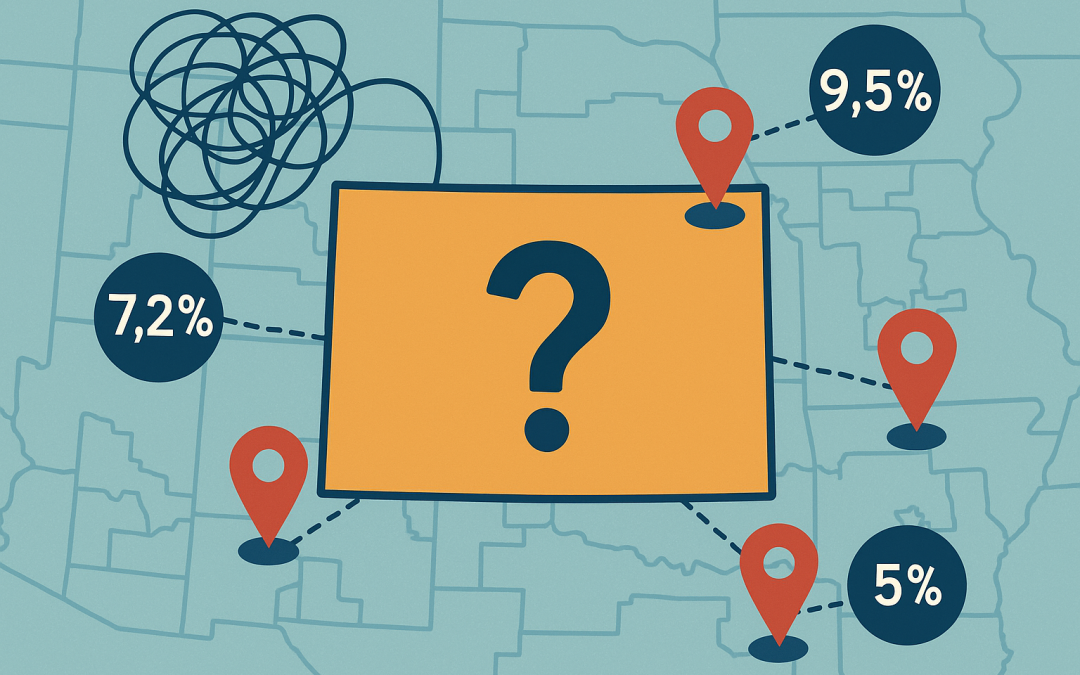
If you run an ecommerce business, and sell into Colorado, you already know that Colorado sales tax rules can drive you nuts. It’s not just the state tax, it’s the patchwork of home rule cities that insist on collecting their own. For a solopreneur, this can feel like death by a thousand cuts.
I get asked about this a lot, usually after someone gets a letter from the state or stumbles into a Facebook group where other business owners are venting about how they’ve stopped selling into Colorado altogether. The frustration is real, and you are not alone.
Why Colorado Is Different
In most states, sales tax is centralized. You register once, the state collects both state and local taxes, and you file in one place. Done.
Colorado is different. Over 70 home rule cities get to collect their own tax, and many of them do not use the state’s system. That means, in theory, you would need to file returns in dozens of separate jurisdictions, sometimes for just a couple of dollars in sales.
Other states that cause headaches are Louisiana, Alabama, and Alaska. They have all tried to fix things with centralized portals or flat rates, but Colorado hangs onto local control. That is why you see so many sellers throwing their hands up and saying, “Forget it.”
What’s Changed (and What Hasn’t)
Colorado introduced something called SUTS (Simplified Sales and Use Tax System). About 40 home rule cities, including Pueblo, are in SUTS now. This means you can file for them through the same portal you use for the state. That’s progress.
On top of that, a 2024 law clarified that if you do not have a physical presence in a home rule city, like a store, office, or warehouse, they cannot force you to register with them directly. So if you are just making a few online sales into Boulder or Denver, you don’t necessarily have to file there separately.
The catch is nexus.
If you sell more than $100,000 into Colorado in a year, you have economic nexus, and you are required to collect and remit state and local taxes.
If you have physical nexus, such as inventory in a warehouse, you are also on the hook.
The Real Problem for Small Sellers
Here is where the pain comes in. Let’s say you sell one product in Longmont for $27. Technically, that is a few cents of city tax. If you had to register, track, and file in Longmont just for that, you would spend more on filing than you made on the sale.
Big companies can afford Avalara or TaxJar to automate filings across all those jurisdictions. For a solopreneur, those tools often cost more than your profits. Platforms like Shopify or Squarespace do not solve the Colorado problem either. They either skip home rule jurisdictions or dump the data on you in a CSV and say, “Good luck.”
Colorado SUTS Cities (as of 2025)
Here are some of the larger home rule cities that participate in SUTS. This list is not complete, but it covers many of the ones you are most likely to run into:
| In SUTS (file through portal) | Not in SUTS (file separately) |
|---|---|
| Pueblo | Colorado Springs |
| Aurora | Aspen |
| Boulder | Castle Rock |
| Denver | Steamboat Springs |
| Fort Collins | Vail |
| Lakewood | Winter Park |
| Longmont | Black Hawk |
| Thornton | Sterling |
| Westminster | Fountain |
| Arvada | Monument |
If you sell into a city on the left, you can file through SUTS. If it is on the right, you may need to file directly if you have nexus there.
What About Other States?
Colorado is one of the toughest, but it is not the only place where ecommerce sellers get tripped up. Every state with sales tax has its own economic nexus threshold, and most are either $100,000 in sales or 200 transactions in a year. A few, like California, set the threshold higher, and some have eliminated the transaction count and only go by revenue.
What this means is that even if you live in Colorado, you may be required to collect and remit tax in other states once you cross those thresholds. The key is to know where your customers are, watch your total sales by state, and only worry about registering where you truly have nexus.
The good news is that outside of Colorado, you don’t have to deal with dozens of city level filings. Once you register with a state, you are usually covered for all local jurisdictions in that state.
So How Do You Stay Sane?
Here’s the practical playbook I share with clients:
Register with the state and get into the SUTS system. That covers the state rate plus a good chunk of home rule cities.
Know your nexus. If you are under $100K in Colorado sales and do not have physical presence, you are mostly safe sticking with state and SUTS filings.
Track sales by city and state. Even if it is just a spreadsheet you update once a month, knowing where your customers are keeps you from being blindsided later.
Prioritize big jurisdictions. If you start getting real traction in Denver, Boulder, or Colorado Springs, then it is worth taking a closer look at compliance there. Do not lose sleep over one order in a tiny town.
Balance risk and reward. Many small sellers make a business decision not to file in every corner of Colorado. It is not about ignoring the law, it is about recognizing that the administrative cost of chasing down pennies can outweigh the potential fine.
The Bigger Picture
Does this system hurt small businesses? Absolutely. Some sellers even stop shipping to Colorado because of it. That limits consumer choice and punishes entrepreneurs who are trying to do the right thing.
Until every home rule city joins SUTS, or Colorado decides to centralize, this is the reality we are stuck with. But you can still operate without losing your mind if you focus on:
Staying in the state system
Using SUTS for what it covers
Keeping good records
Making smart decisions about when it is worth going further
Final Word
Ecommerce is supposed to give you freedom, not trap you in paperwork. If you have been stressing over whether you are “doing it right,” take a breath. You are not crazy, the system really is that complex. But with the right approach, you can stay mostly compliant, keep your sanity, and avoid spending more on filing than you earn on sales.








 Guest Posting

