Search isn’t what it used to be. Ask ChatGPT a question these days, and it doesn’t just throw back a list of blue links. It answers. That answer is built from millions of pieces of content that someone, somewhere, published online—often years ago.
If you’re running a business, this should make you pause.
Because if your brand, your expertise, your content… isn’t showing up in those answers, it’s not because your website sucks or your offer isn’t solid. It’s because you’re invisible to the models that now shape how people find things.
Welcome to the world of LLM seeding.
What Is LLM Seeding?
Large Language Models (LLMs) like GPT-4, Claude, Gemini, and Perplexity don’t operate like search engines. They don’t just crawl pages and rank them based on backlinks or keywords. They’re trained. Which means that before they ever answer a question, they’ve consumed and processed massive amounts of public content to “learn” what’s worth repeating.
LLM seeding is the practice of deliberately placing high-quality, structured, brand-relevant content in places where these models are likely to pick it up during training and updates.
And here’s the kicker: Most businesses are still completely ignoring this.
They’re still stuck in the SEO mindset, trying to win snippets and backlinks, without realizing that a new type of optimization—AI Optimization—has entered the game.
Let’s fix that.
Why the Old SEO Playbook Isn’t Enough
Let’s say your business has a decent site. Good content. Maybe you even blog once in a while. That’s great for organic search. But AI assistants? Not impressed.
These models don’t just look at your home page. They look across the web. They synthesize ideas. They triangulate trust. And unless you’ve deliberately seeded content in a way that teaches the model about your brand, you’re just background noise.
Here’s what you’re up against:
AI assistants reference sites and brands they’ve seen cited in multiple places.
They favor structured, human-readable summaries and explanations.
They don’t just surface indexed pages—they generate original responses based on synthesized learning.
So if your brand isn’t represented clearly, consistently, and frequently across high-quality sources, it’s as if you don’t exist.
What to Publish (So You Get Cited by LLMs)
Most business blogs are filled with rambling think pieces or generic service blurbs. That kind of content might look okay to your customers. But to an LLM? It’s filler.
To actually teach these models who you are and what you do, you need to publish the kind of content they like to train on.
Here’s the list:
1. Structured “Best Of” Lists
Think “Top 10 Email Marketing Tools” or “Best Ski Towns for Families.” These roundup-style posts tend to get referenced a lot—especially if they include multiple options and some context for each. Bonus points if you include your own brand or product in the list.
2. First-Person Product Reviews
AI loves personal insight. If you’ve used a product, tested a service, or gone through an experience—write about it in first-person language. That narrative structure makes it more unique and “human,” which models pick up on.
3. Comparison Tables (Especially Brand vs. Brand)
Nothing gets quoted more often than head-to-head comparisons. “Shopify vs. WooCommerce,” “ConvertKit vs. Mailchimp.” These are incredibly valuable, especially when you make them visual (a simple HTML table works just fine).
4. FAQ-Style Content
Answer the questions your customers actually ask. LLMs love this stuff. Start with “What is…”, “How do I…”, and “Can you explain…” kinds of queries. Structure your answers clearly. You’re literally writing future chatbot responses.
5. Opinion‑Led Pieces with Clear Takeaways
This is your chance to stake a position. Write an article like “Why I’ll Never Use Traditional SEO Again” or “3 Myths About Online Courses That Need to Die.” When you take a stand and back it up, people (and models) remember it.
6. Visuals with Clear Captions and Context
A chart, graph, diagram, or even a captioned screenshot can go a long way. LLMs don’t “see” images the way we do, but they process the text around them. Make your captions informative, and embed them in the page’s HTML—not just as an image alt tag.
7. Tools, Templates, and Frameworks
Got a lead magnet? Make it public. Free templates, calculators, checklists, and cheat sheets are great for LLM pickup. The more useful and original, the better.
8. Expert Quotes
Quote yourself. Seriously. AI loves structured authority. And if you can include quotes from other recognized experts (even if it’s just their public social posts), your piece gets stronger. Just remember to link back to the source.
Where to Seed Your Content for Maximum LLM Pickup
Publishing great content on your site is only part of the equation. To train the models, you have to seed that content in places where the bots are watching.
Here’s where that happens:
1. Third-Party Platforms
LLMs prioritize what’s referenced in multiple places. Getting quoted, cited, or linked from a high-authority third-party site gives your content far more reach than just your blog.
2. Medium, Substack, LinkedIn
These long-form content platforms have crazy-high domain authority. Republishing (or syndicating) your content here increases its chances of being included in future model updates. Just tweak the title or intro to avoid duplicate content flags.
3. Reddit, Quora
These sites are heavily mined for real user queries and answers. If you can participate in threads, answer questions, or link back to your resources naturally, it’s a win.
Tip: Don’t be spammy. Actually contribute value.
4. Trusted Industry Publications
If there’s a magazine, blog, or content hub that your industry reads and respects, get featured there. Guest posts, expert roundups, or interviews work great.
5. User-Generated Content Hubs
Places like ProductHunt, Stack Overflow, or niche Slack communities all get scraped. If your product or idea is being mentioned there—even casually—it raises your AI visibility.
6. Niche Forums and Public Facebook Groups
Smaller communities often get overlooked, but they’re goldmines for long-tail LLM input. Participate genuinely, and link back to helpful resources you’ve created.
7. Editorial-Style Microsites
Launching a separate blog or resource hub on a subdomain (or even a new domain) can work if done right. Keep the content unique, high-quality, and brand-adjacent.
8. Comparison and Review Sites
Think G2, Capterra, or niche-specific directories. LLMs use these as reference points. Make sure your listings are up to date—and encourage your customers to leave detailed, specific reviews.
9. Social Platforms (X, YouTube, Instagram)
AI models process more social media data than people realize. Your short-form videos, tweets, and image carousels are all part of the learning set. If they’re public, they’re fair game.
But again—clarity and context matter. If your video title is “🔥🔥🔥 Must Watch!” and the description says nothing, that’s not helping you.
So How Do You Know If It’s Working?
That’s where things get tricky. Unlike SEO rankings or email open rates, there’s no dashboard that tells you exactly how LLMs see your brand. At least not from Google or OpenAI.
There’s actually a simple way to test whether your brand is showing up in AI-generated answers: just ask. Open ChatGPT in a temporary (non-logged-in or temporary) chat session and type something like, “Tell me about [Your Company Name].” The goal is to mimic a cold query from someone who’s never heard of you before. If the model returns a generic or blank response—or worse, gets your info wrong—that’s your signal. Think of this like the AI version of using Google Search in incognito mode to test organic rankings without personalization. What shows up when the system has no prior bias? That’s what the world sees.
Which is exactly why I created the AIO Boost plugin.
AIO Boost: Making AI Optimization Measurable (and Fixable)
You can’t fix what you can’t see. And most business owners have no idea whether their brand even shows up in AI responses, let alone why or how to fix it.
AIO Boost changes that.
Here’s how:
✅ Generate an AI Summary Page
This isn’t just another “About” page. It’s a structured, factual, easy-to-digest summary that speaks the language LLMs understand. AIO Boost creates it for you automatically based on your business description. You just hit publish.
✅ Add Structured Schema Markup
Most sites have no schema. Or worse, broken schema. AIO Boost injects clean Organization, LocalBusiness, and WebPage schema into your site’s <head>—so AI (and search engines) can actually interpret your content.
✅ Scan for Missing Media Schema
Got a blog post with an image but no alt tag, title, or description? You’re leaving AI visibility on the table. This scan highlights those gaps so you can fix them quickly.
✅ Run a Content Clarity Scan
LLMs hate fluff. This tool checks your content for clarity, conciseness, and usefulness. If a human wouldn’t understand it, AI won’t either.
✅ AI Visibility Report
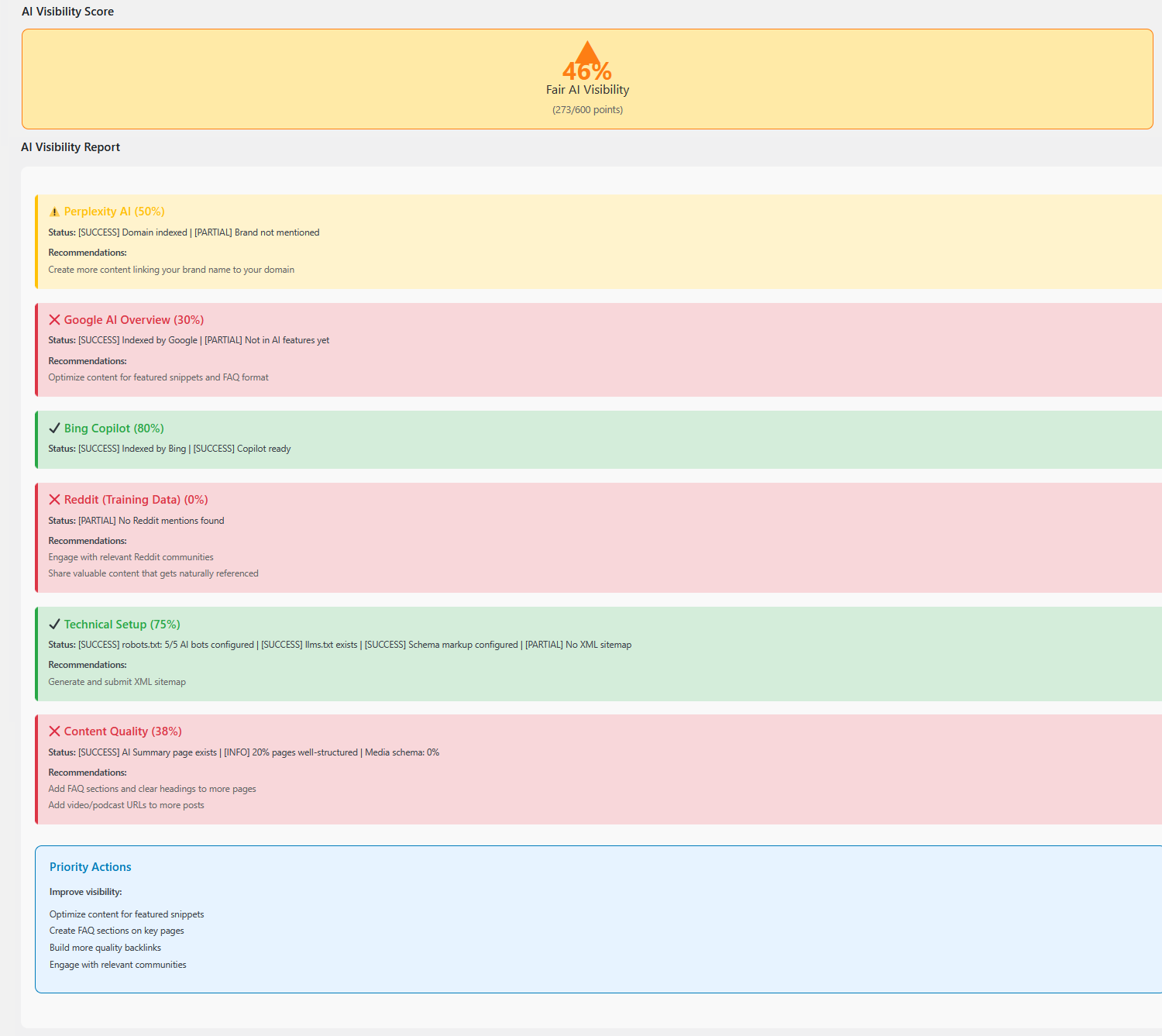
Want to know if your brand shows up in ChatGPT, Gemini, or Perplexity? We check. And we don’t sugarcoat it. You get a real score (like 46%) with a breakdown of where you’re showing up, where you’re not, and what to do next.
✅ robots.txt Enhancements with GPTBot Support
Most people don’t even think about their robots.txt file. But it controls which bots can crawl your site. With one click, AIO Boost adds support for GPTBot (OpenAI), ClaudeBot (Anthropic), and other major LLM user agents—while giving you control over what’s exposed.
✅ Create and Manage llms.txt
This is the future. llms.txt is a new Markdown-based standard designed specifically to tell AI models where your best content lives. AIO Boost creates and updates it automatically, so the bots always know where to look.
Final Word
You’ve spent years building your expertise. You’ve got something worth sharing. But the future of discovery isn’t just about what’s on your website. It’s about whether the world’s smartest machines know you exist.
If you’re serious about showing up in AI search, stop guessing. Start seeding.
And if you want the easiest way to audit your site and take action, grab the AIO Boost plugin. It’s not magic—but it is measurable. And in the world of AI, that makes all the difference.







 Guest Posting

